Thermal Properties of Matter — Class 11 Maharashtra HSC Physics revision notes
A 7-page visual revision sheet for Thermal Properties of Matter, written for Class 11 Maharashtra HSC Physics. Formulas, diagrams and the traps that cost marks, laid out to be read the night before rather than the term before. Free, and it opens inside CapCompass.
 Page 1 as PDF
Thermal Properties of Matter in one look
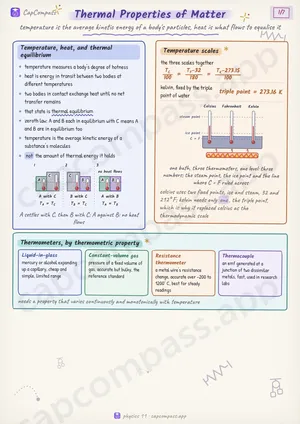
temperature is the average kinetic energy of a body's particles, heat is what flows to equalise it
Temperature, heat, and thermal equilibrium
- temperature measures a body's degree of hotness
- heat is energy in transit between two bodies at different temperatures
- two bodies in contact exchange heat until no net transfer remains
- that state is thermal equilibrium
- zeroth law: A and B each in equilibrium with C means A and B are in equilibrium too
- temperature is the average kinetic energy of a substance's molecules
- not the amount of thermal energy it holds
Temperature scales
- the three scales together
T_C/100 = T_F-32/180 = T_K-273.15/100 - kelvin, fixed by the triple point of water
triple point = 273.16 K
Thermometers, by thermometric property
- Liquid-in-glass: mercury or alcohol expanding up a capillary, cheap and simple, limited range
- Constant-volume gas: pressure of a fixed volume of gas, accurate but bulky, the reference standard
- Resistance thermometer: a metal wire's resistance change, accurate over -200 to 1200 degrees C, best for steady readings
- Thermocouple: an emf generated at a junction of two dissimilar metals, fast, used in research labs
Page 1 of 7. The full sheet, all 7 pages, opens free in the app.
What this Thermal Properties of Matter sheet covers
- Temperature, heat, and thermal equilibrium
- Temperature scales
- the three scales together
- kelvin, fixed by the triple point of water
- Thermometers, by thermometric property
- Liquid-in-glass
- Constant-volume gas
- Resistance thermometer
- Thermocouple
- Ideal gas equation
- Boyle's law
- Charles' law
- combined, n moles
- universal gas constant
- Gas laws as special cases
- Gas vs vapour
- Thermal expansion
- linear expansion
- area expansion
- volume expansion
- same material: β = 2α, γ = 3α
- Anomalous expansion of water
- Specific and molar heat capacity
- Heat equation and heat capacity
- heat exchanged
- heat capacity of a body, C = ms
- Calorimetry, method of mixtures
- heat lost by the hot sample A
- heat gained by calorimeter, stirrer and water
- Change of state
- Heating curve of ice, start to finish
- ice
- melting
- water
- boiling
- steam
- Latent heat
- heat for a change of state, no temperature change
- latent heat of fusion, water at 0 degrees C
- latent heat of vaporisation, water at 100 degrees C
- Conduction
- Thermal conductivity and resistance
- rate of heat flow, rod length x, area A
- thermal resistance
- Convection and radiation
- Conduction vs convection vs radiation
- Newton's law of cooling
- rate of cooling, small excess over surroundings
- Thermal stress in a clamped rod
- Traps that cost marks
- Tricks that save time
How CapCompass uses this sheet
These notes are not a standalone PDF. CapCompass plans Physics chapter by chapter against your real exam dates and free hours, and when the plan reaches Thermal Properties of Matter the sheet opens inside the study block itself — at the page covering the sub-topic that block is on, with the timer still running. Revision arrives at the moment the plan says revise, instead of having to be gone looking for.