AC Circuits — Class 12 Maharashtra HSC Physics revision notes
A 5-page visual revision sheet for AC Circuits, written for Class 12 Maharashtra HSC Physics. Formulas, diagrams and the traps that cost marks, laid out to be read the night before rather than the term before. Free, and it opens inside CapCompass.
 Page 1 as PDF
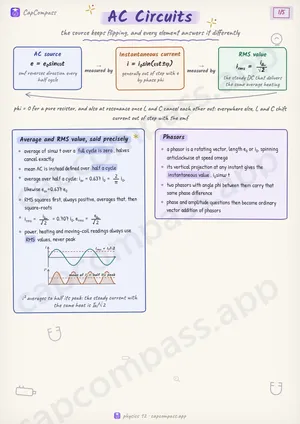
AC Circuits in one look
the source keeps flipping, and every element answers it differently
- AC source: emf reverses direction every half cycle
- Instantaneous current: generally out of step with e by phase phi
- RMS value: the steady DC that delivers the same average heating
Average and RMS value, said precisely
- average of sinω t over a full cycle is zero, halves cancel exactly
- mean AC is instead defined over half a cycle
- average over half a cycle: i_av = 0.637 i_0 = 2/pii_0, likewise e_av=0.637 e_0
- RMS squares first, always positive, averages that, then square-roots
- i_rms = i_0/√2 = 0.707 i_0, e_rms = e_0/√2
- power, heating and moving-coil readings always use RMS values, never peak
Phasors
- a phasor is a rotating vector, length e_0 or i_0, spinning anticlockwise at speed omega
- its vertical projection at any instant gives the instantaneous value, i_0sinω t
- two phasors with angle phi between them carry that same phase difference
- phase and amplitude questions then become ordinary vector addition of phasors
Page 1 of 5. The full sheet, all 5 pages, opens free in the app.
What this AC Circuits sheet covers
- AC source
- Instantaneous current
- RMS value
- average value
- Average and RMS value, said precisely
- phasor
- Phasors
- AC through R, L, C alone
- Resistor
- Inductor
- Capacitor
- impedance
- lcr circuit
- Impedance of a series LCR circuit
- voltage across each element, same current i throughout
- e_L and e_C are 180 degrees out of phase, so they subtract
- dividing through by i_0 gives the impedance
- phase angle by which emf leads current
- Impedance, the special forms
- power factor
- wattless current
- Power in an AC circuit
- average power over a full cycle
- power factor, from the impedance triangle
- pure R, non-inductive circuit, X_L=X_C
- pure L or pure C alone
- lc oscillations
- Series vs parallel resonance
- Series vs parallel resonant circuit
- Series (acceptor)
- Parallel (rejector)
- q factor
- quality factor
- bandwidth
- Sharpness of resonance, the Q factor
- half-power points, symmetric about the resonant angular frequency
- bandwidth, current falls to 1/√2 of peak at its edges
- choke coil
- Symbols
- Traps that cost marks
- Tricks that save time
How CapCompass uses this sheet
These notes are not a standalone PDF. CapCompass plans Physics chapter by chapter against your real exam dates and free hours, and when the plan reaches AC Circuits the sheet opens inside the study block itself — at the page covering the sub-topic that block is on, with the timer still running. Revision arrives at the moment the plan says revise, instead of having to be gone looking for.
More Physics Class 12 revision notes
- Current Electricity
- Dual Nature of Radiation and Matter
- Electromagnetic Induction
- Electrostatics
- Kinetic Theory of Gases and Radiation
- Magnetic Fields due to Electric Current
- Magnetic Materials
- Mechanical Properties of Fluids
- Oscillations
- Rotational Dynamics
- Semiconductor Devices
- Structure of Atoms and Nuclei
- Superposition of Waves
- Thermodynamics
- Wave Optics