Superposition of Waves — Class 12 Maharashtra HSC Physics revision notes
A 7-page visual revision sheet for Superposition of Waves, written for Class 12 Maharashtra HSC Physics. Formulas, diagrams and the traps that cost marks, laid out to be read the night before rather than the term before. Free, and it opens inside CapCompass.
 Page 1 as PDF
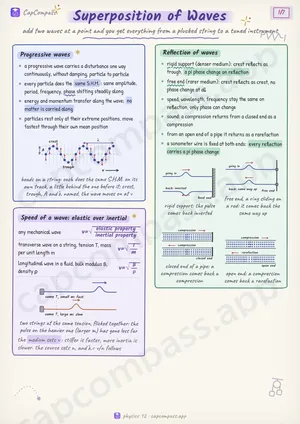
Superposition of Waves in one look
add two waves at a point and you get everything from a plucked string to a tuned instrument
Progressive waves
- a progressive wave carries a disturbance one way continuously, without damping, particle to particle
- every particle does the same S.H.M.: same amplitude, period, frequency, phase shifting steadily along
- energy and momentum transfer along the wave; no matter is carried along
- particles rest only at their extreme positions, move fastest through their own mean position
Speed of a wave: elastic over inertial
- any mechanical wave
v=√fracelastic propertyinertial property - transverse wave on a string, tension T, mass per unit length m
v=√T/m - longitudinal wave in a fluid, bulk modulus B, density ρ
v=√B/ρ
Reflection of waves
- rigid support (denser medium): crest reflects as trough, a pi phase change on reflection
- free end (rarer medium): crest reflects as crest, no phase change at all
- speed, wavelength, frequency stay the same on reflection, only phase can change
- sound: a compression returns from a closed end as a compression
- from an open end of a pipe it returns as a rarefaction
- a sonometer wire is fixed at both ends: every reflection carries a pi phase change
Page 1 of 7. The full sheet, all 7 pages, opens free in the app.
What this Superposition of Waves sheet covers
- progressive wave
- Progressive waves
- Speed of a wave: elastic over inertial
- any mechanical wave
- transverse wave on a string, tension T, mass per unit length m
- longitudinal wave in a fluid, bulk modulus B, density ρ
- reflection of waves
- The principle of superposition
- interference
- Interference of two waves, same frequency
- resultant amplitude, phase difference phi
- waves in phase, φ = 0
- waves out of phase, φ = π
- phase difference from a path difference Δ
- stationary waves
- Formation of stationary waves
- Nodes and antinodes
- nodes: zero amplitude, permanently at rest
- antinodes: maximum amplitude A
- node to next antinode
- Progressive waves vs stationary waves
- Stationary wave
- harmonics
- overtones
- Harmonics and overtones
- Free vibrations, forced vibrations and resonance
- End correction
- Air column closed at one end
- fundamental frequency, length L
- allowed frequencies
- Air column open at both ends
- In the lab: the resonance tube
- Pipe frequencies: the special forms
- vibrating string
- sonometer
- Laws of a vibrating string
- fundamental frequency, tension T, mass per length m
- law of length, T and m fixed
- law of tension, l and m fixed
- law of linear density, T and l fixed
- String laws: the special ratios
- In the lab: the sonometer
- beats
- two sources, close frequencies n_1 and n_2
- period of beats
- Applications of beats
- Doppler effect
- source and listener approaching each other, speeds v_s and v_L
- moving apart: flip both signs
- source moving at an angle θ to the line of sight
- Symbols
- Traps that cost marks
- Tricks that save time
How CapCompass uses this sheet
These notes are not a standalone PDF. CapCompass plans Physics chapter by chapter against your real exam dates and free hours, and when the plan reaches Superposition of Waves the sheet opens inside the study block itself — at the page covering the sub-topic that block is on, with the timer still running. Revision arrives at the moment the plan says revise, instead of having to be gone looking for.
More Physics Class 12 revision notes
- AC Circuits
- Current Electricity
- Dual Nature of Radiation and Matter
- Electromagnetic Induction
- Electrostatics
- Kinetic Theory of Gases and Radiation
- Magnetic Fields due to Electric Current
- Magnetic Materials
- Mechanical Properties of Fluids
- Oscillations
- Rotational Dynamics
- Semiconductor Devices
- Structure of Atoms and Nuclei
- Thermodynamics
- Wave Optics