Current Electricity — Class 12 Maharashtra HSC Physics revision notes
A 7-page visual revision sheet for Current Electricity, written for Class 12 Maharashtra HSC Physics. Formulas, diagrams and the traps that cost marks, laid out to be read the night before rather than the term before. Free, and it opens inside CapCompass.
 Page 1 as PDF
Current Electricity in one look
Kirchhoff's laws, the bridges built on them, and the null-deflection potentiometer
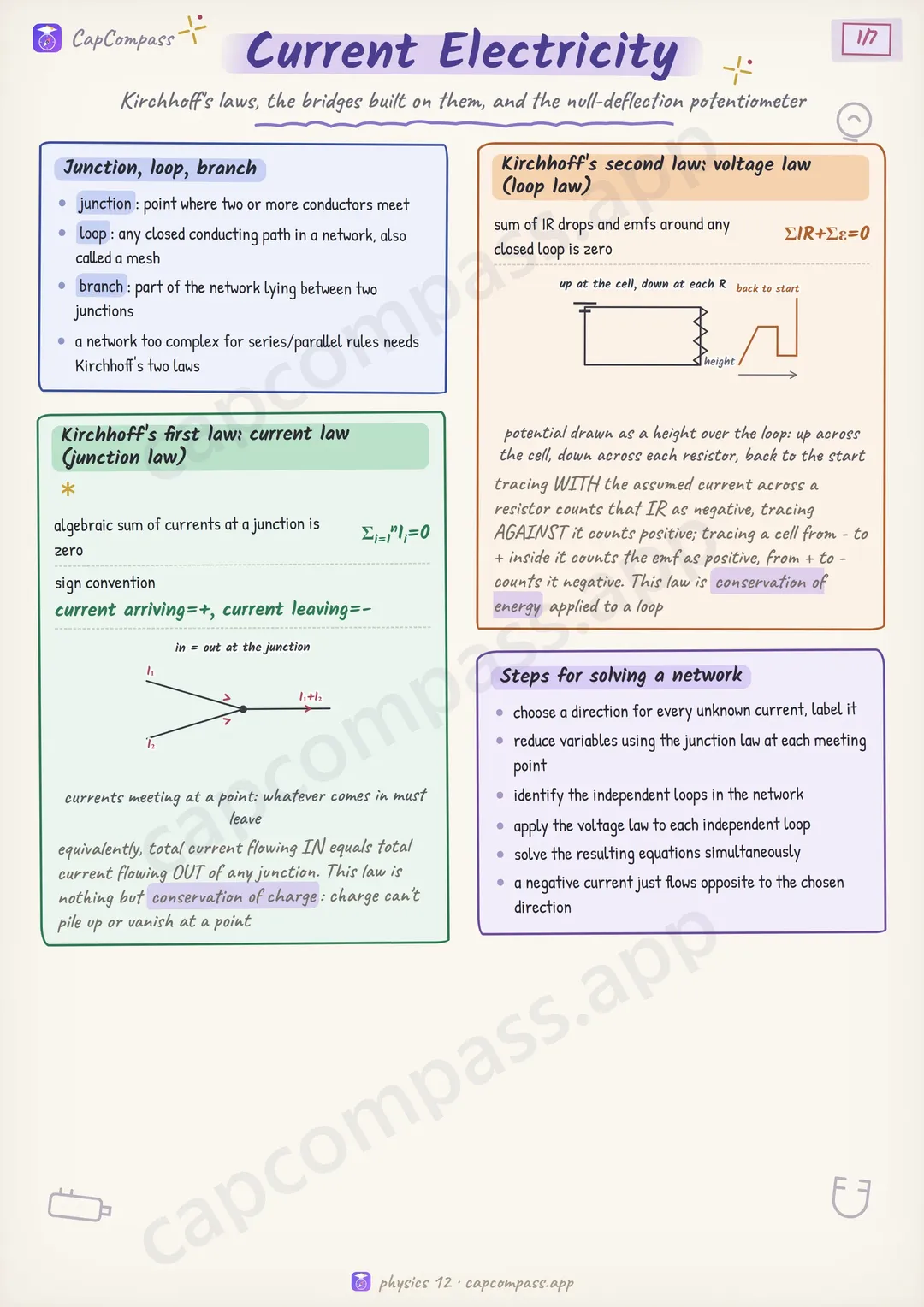
Junction, loop, branch
- junction: point where two or more conductors meet
- loop: any closed conducting path in a network, also called a mesh
- branch: part of the network lying between two junctions
- a network too complex for series/parallel rules needs Kirchhoff's two laws
Kirchhoff's first law: current law (junction law)
- algebraic sum of currents at a junction is zero
Σ_i=1^nI_i=0 - sign convention
current arriving=+, current leaving=-
Kirchhoff's second law: voltage law (loop law)
- sum of IR drops and emfs around any closed loop is zero
Σ IR+Σε=0
Steps for solving a network
- choose a direction for every unknown current, label it
- reduce variables using the junction law at each meeting point
- identify the independent loops in the network
- apply the voltage law to each independent loop
- solve the resulting equations simultaneously
- a negative current just flows opposite to the chosen direction
Page 1 of 7. The full sheet, all 7 pages, opens free in the app.
What this Current Electricity sheet covers
- junction
- loop
- branch
- Junction, loop, branch
- kirchhoff's first law
- junction law
- Kirchhoff's first law: current law (junction law)
- algebraic sum of currents at a junction is zero
- sign convention
- kirchhoff's second law
- loop law
- voltage law
- Kirchhoff's second law: voltage law (loop law)
- sum of IR drops and emfs around any closed loop is zero
- Steps for solving a network
- wheatstone bridge
- The Wheatstone bridge
- balanced wheatstone bridge
- balance condition
- loop ABDA with I_g=0
- loop BCDB with I_g=0
- dividing the two, the balance condition
- Applications of the bridge
- metre bridge
- The metre bridge
- metre bridge balance
- unknown resistance metre bridge
- balance condition, l_x and l_R the two wire lengths
- unknown resistance
- specific resistance of the unknown wire X, radius r, length L
- post office box
- The post office box
- Metre bridge vs post office box
- potentiometer
- Potentiometer, the principle
- comparing emf
- sum and difference method
- Comparing the emf of two cells
- null lengths l_1 and l_2 correspond to emf epsilon_1 and epsilon_2
- so the emfs compare directly as lengths
- sum and difference method, componendo-dividendo
- internal resistance
- internal resistance of a cell
- open circuit, null length l_1 corresponds to emf epsilon
- closed through a known resistance R, null length l_2 corresponds to terminal voltage V
- voltage divider
- Potentiometer as a voltage divider
- galvanometer to ammeter
- shunt resistance
- Galvanometer to ammeter: the shunt
- shunt S in parallel carries the rest of the current, GI_g=S(I-I_g)
- to extend the range n times, I=nI_g
- fraction of the total current through the shunt
- galvanometer to voltmeter
- series resistance voltmeter
- Galvanometer to voltmeter: the series resistor
- resistance X in series drops the remaining voltage, V=I_g(G+X)
- to extend the range n_V times
- Symbols
- Charging and discharging a capacitor
- Endless ladders and symmetric networks
- Traps that cost marks
- Tricks that save time
How CapCompass uses this sheet
These notes are not a standalone PDF. CapCompass plans Physics chapter by chapter against your real exam dates and free hours, and when the plan reaches Current Electricity the sheet opens inside the study block itself — at the page covering the sub-topic that block is on, with the timer still running. Revision arrives at the moment the plan says revise, instead of having to be gone looking for.
More Physics Class 12 revision notes
- AC Circuits
- Dual Nature of Radiation and Matter
- Electromagnetic Induction
- Electrostatics
- Kinetic Theory of Gases and Radiation
- Magnetic Fields due to Electric Current
- Magnetic Materials
- Mechanical Properties of Fluids
- Oscillations
- Rotational Dynamics
- Semiconductor Devices
- Structure of Atoms and Nuclei
- Superposition of Waves
- Thermodynamics
- Wave Optics