Wave Optics — Class 12 Maharashtra HSC Physics revision notes
A 7-page visual revision sheet for Wave Optics, written for Class 12 Maharashtra HSC Physics. Formulas, diagrams and the traps that cost marks, laid out to be read the night before rather than the term before. Free, and it opens inside CapCompass.
 Page 1 as PDF
Wave Optics in one look
light interferes, diffracts and polarises: the wave picture ray optics never needed
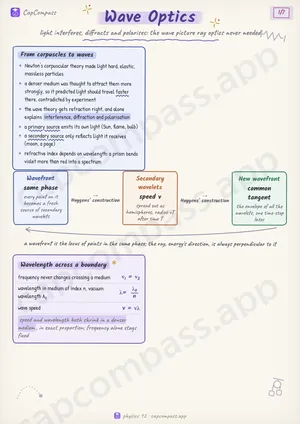
From corpuscles to waves
- Newton's corpuscular theory made light hard, elastic, massless particles
- a denser medium was thought to attract them more strongly, so it predicted light should travel faster there, contradicted by experiment
- the wave theory gets refraction right, and alone explains interference, diffraction and polarisation
- a primary source emits its own light (Sun, flame, bulb)
- a secondary source only reflects light it receives (moon, a page)
- refractive index depends on wavelength: a prism bends violet more than red into a spectrum
- Wavefront: every point on it becomes a fresh source of secondary wavelets
- Secondary wavelets: spread out as hemispheres, radius vT after time T
- New wavefront: the envelope of all the wavelets, one time-step later
Wavelength across a boundary
- frequency never changes crossing a medium
ν_1 = ν_2 - wavelength in medium of index n, vacuum wavelength λ_0
λ = λ_0/n - wave speed
v = νλ
Page 1 of 7. The full sheet, all 7 pages, opens free in the app.
What this Wave Optics sheet covers
- From corpuscles to waves
- Wavefront
- Secondary wavelets
- New wavefront
- Wavelength across a boundary
- frequency never changes crossing a medium
- wavelength in medium of index n, vacuum wavelength λ_0
- wave speed
- Reflection and refraction, from the wavefront
- Coherence, the condition for a stable pattern
- Three ways to get two coherent sources
- Young's double slit
- Lloyd's mirror
- Fresnel biprism
- double slit
- young's experiment
- path difference at a point on the screen
- bright fringe, n=0,±1,±2,...
- dark fringe
- fringe width
- Path difference: bright, dark, and the centre
- The intensity pattern
- Slit separation from fringe count
- diffraction
- single slit
- Diffraction at a single slit
- nth minimum, slit width a
- angular half-width of the central maximum
- fringe width, except the central band
- Interference vs diffraction pattern
- Single slit diffraction
- resolving power
- rayleigh criterion
- Resolving power, telescope and microscope
- telescope, limit of resolution, aperture D
- telescope's resolving power
- microscope, minimum resolvable separation, refractive index n, half-angle alpha
- polarisation
- Malus's law and Brewster's law
- intensity after a second Polaroid at angle theta to the first
- crossed Polaroids, theta = 90 degree
- Brewster's angle, reflected ray fully polarised
- Polarisation by scattering
- Symbols
- Thin films and coatings
- Air wedge and Newton's rings
- The diffraction grating
- Traps that cost marks
- Tricks that save time
How CapCompass uses this sheet
These notes are not a standalone PDF. CapCompass plans Physics chapter by chapter against your real exam dates and free hours, and when the plan reaches Wave Optics the sheet opens inside the study block itself — at the page covering the sub-topic that block is on, with the timer still running. Revision arrives at the moment the plan says revise, instead of having to be gone looking for.
More Physics Class 12 revision notes
- AC Circuits
- Current Electricity
- Dual Nature of Radiation and Matter
- Electromagnetic Induction
- Electrostatics
- Kinetic Theory of Gases and Radiation
- Magnetic Fields due to Electric Current
- Magnetic Materials
- Mechanical Properties of Fluids
- Oscillations
- Rotational Dynamics
- Semiconductor Devices
- Structure of Atoms and Nuclei
- Superposition of Waves
- Thermodynamics