Structure of Atoms and Nuclei — Class 12 Maharashtra HSC Physics revision notes
A 7-page visual revision sheet for Structure of Atoms and Nuclei, written for Class 12 Maharashtra HSC Physics. Formulas, diagrams and the traps that cost marks, laid out to be read the night before rather than the term before. Free, and it opens inside CapCompass.
 Page 1 as PDF
Structure of Atoms and Nuclei in one look
Rutherford found the nucleus, Bohr made it stable, and the nucleus itself hides the energy of stars and reactors
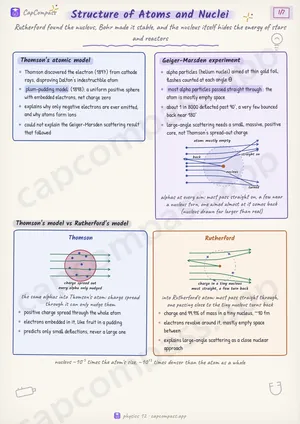
Thomson's atomic model
- Thomson discovered the electron (1897) from cathode rays, disproving Dalton's indestructible atom
- plum-pudding model (1898): a uniform positive sphere with embedded electrons, net charge zero
- explains why only negative electrons are ever emitted, and why atoms form ions
- could not explain the Geiger-Marsden scattering result that followed
Geiger-Marsden experiment
- alpha particles (helium nuclei) aimed at thin gold foil, flashes counted at each angle θ
- most alpha particles passed straight through: the atom is mostly empty space
- about 1 in 8000 deflected past 90 degrees, a very few bounced back near 180 degrees
- large-angle scattering needs a small, massive, positive core, not Thomson's spread-out charge
Thomson's model vs Rutherford's model
- positive charge spread through the whole atom
- electrons embedded in it, like fruit in a pudding
- predicts only small deflections, never a large one
- charge and 99.9% of mass in a tiny nucleus, ~10 fm
- electrons revolve around it, mostly empty space between
- explains large-angle scattering as a close nuclear approach
Page 1 of 7. The full sheet, all 7 pages, opens free in the app.
What this Structure of Atoms and Nuclei sheet covers
- thomson's atomic model
- plum pudding model
- geiger-marsden experiment
- alpha particle scattering
- Thomson's model vs Rutherford's model
- Thomson
- Rutherford
- Difficulties with Rutherford's model
- atomic spectra
- line spectrum
- Atomic spectra: line spectra and series
- bohr's postulates
- bohr's atomic model
- Radius and speed of the nth orbit
- radius, hydrogen-like atom of atomic number Z
- Bohr radius, n=1, Z=1
- orbital speed
- energy of electron
- ionization energy
- excitation energy
- Energy of the nth orbit
- total energy, hydrogen-like atom
- ground state of hydrogen, n=1
- photon emitted on a transition, m to n, m>n
- Energy and radius: the limits
- Rydberg formula
- wave number of an emitted line
- Rydberg constant
- de broglie explanation
- limitations of bohr's model
- De Broglie's explanation and limitations of Bohr's model
- Protons
- Neutrons
- Nucleons
- atomic mass unit
- unified atomic mass unit
- Units for nuclear masses
- Size and density of the nucleus
- nuclear radius
- nuclear density, since volume goes as A
- typical value
- nuclear force
- strong force
- The nuclear force
- mass defect
- binding energy
- Mass defect and binding energy
- binding energy per nucleon, a measure of stability
- Binding energy per nucleon vs mass number
- peaks near
- typical mid-range value
- hydrogen, single proton
- radioactive decay
- alpha decay
- beta decay
- gamma decay
- Radioactive decay: alpha, beta, gamma
- What each decay changes
- decay law
- half-life
- average life
- activity
- The decay law
- activity, rate of decay
- number remaining
- average (mean) life
- The decay curve: special points
- nuclear fission
- nuclear fusion
- Nuclear fission vs nuclear fusion
- Fission
- Fusion
- chain reaction
- nuclear reactor
- Chain reaction and the nuclear reactor
- X-rays: the tube, the spectrum, Moseley
- Collisions of electrons with atoms
- Traps that cost marks
- Tricks that save time
How CapCompass uses this sheet
These notes are not a standalone PDF. CapCompass plans Physics chapter by chapter against your real exam dates and free hours, and when the plan reaches Structure of Atoms and Nuclei the sheet opens inside the study block itself — at the page covering the sub-topic that block is on, with the timer still running. Revision arrives at the moment the plan says revise, instead of having to be gone looking for.
More Physics Class 12 revision notes
- AC Circuits
- Current Electricity
- Dual Nature of Radiation and Matter
- Electromagnetic Induction
- Electrostatics
- Kinetic Theory of Gases and Radiation
- Magnetic Fields due to Electric Current
- Magnetic Materials
- Mechanical Properties of Fluids
- Oscillations
- Rotational Dynamics
- Semiconductor Devices
- Superposition of Waves
- Thermodynamics
- Wave Optics