Animal Tissue — Class 11 Maharashtra HSC Biology revision notes
A 6-page visual revision sheet for Animal Tissue, written for Class 11 Maharashtra HSC Biology. Formulas, diagrams and the traps that cost marks, laid out to be read the night before rather than the term before. Free, and it opens inside CapCompass.
 Page 1 as PDF
Animal Tissue in one look
epithelial, connective, muscular, nervous: the four tissues every organ is built from
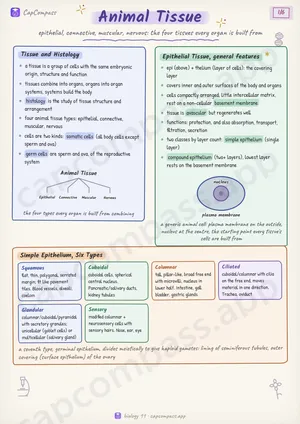
Tissue and Histology
- a tissue is a group of cells with the same embryonic origin, structure and function
- tissues combine into organs, organs into organ systems, systems build the body
- histology is the study of tissue structure and arrangement
- four animal tissue types: epithelial, connective, muscular, nervous
- cells are two kinds: somatic cells (all body cells except sperm and ova)
- germ cells are sperm and ova, of the reproductive system
Epithelial Tissue, general features
- epi (above) + thelium (layer of cells): the covering layer
- covers inner and outer surfaces of the body and organs
- cells compactly arranged, little intercellular matrix, rest on a non-cellular basement membrane
- tissue is avascular but regenerates well
- functions: protection, and also absorption, transport, filtration, secretion
- two classes by layer count: simple epithelium (single layer)
- compound epithelium (two+ layers), lowest layer rests on the basement membrane
Simple Epithelium, Six Types
- Squamous: flat, thin, polygonal, serrated margin; fit like pavement tiles. Blood vessels, alveoli, coelom
- Cuboidal: cuboidal cells, spherical central nucleus. Pancreatic/salivary ducts, kidney tubules
- Columnar: tall, pillar-like, broad free end with microvilli, nucleus in lower half. Intestine, gall bladder, gastric glands
- Ciliated: cuboidal/columnar with cilia on the free end, moves material in one direction. Trachea, oviduct
- Glandular: columnar/cuboidal/pyramidal with secretory granules; unicellular (goblet cells) or multicellular (salivary gland)
- Sensory: modified columnar + neurosensory cells with sensory hairs. Nose, ear, eye
Page 1 of 6. The full sheet, all 6 pages, opens free in the app.
What this Animal Tissue sheet covers
- Tissue and Histology
- Epithelial Tissue, general features
- Simple Epithelium, Six Types
- Squamous
- Cuboidal
- Columnar
- Ciliated
- Glandular
- Sensory
- Exocrine and Endocrine Glands
- Exocrine
- Endocrine
- Cell Junctions
- Compound Epithelium: two types
- Stratified
- Transitional
- Connective Tissue, general features
- Loose Connective Tissue Proper
- Dense Connective Tissue Proper
- Supporting Connective Tissue: Cartilage
- Four Types of Cartilage
- Supporting Connective Tissue: Bone
- Fluid Connective Tissue and Muscular Tissue
- Three Types of Muscle
- The Skeletal Muscle Sarcomere
- Nervous Tissue
- Neurons, by function and by processes
- By function
- By process count
- Myelinated and Non-myelinated Fibres
- Traps that cost marks
- Tricks that save time
How CapCompass uses this sheet
These notes are not a standalone PDF. CapCompass plans Biology chapter by chapter against your real exam dates and free hours, and when the plan reaches Animal Tissue the sheet opens inside the study block itself — at the page covering the sub-topic that block is on, with the timer still running. Revision arrives at the moment the plan says revise, instead of having to be gone looking for.
More Biology Class 11 revision notes
- Biomolecules
- Cell Division
- Cell Structure and Organization
- Excretion and Osmoregulation
- Human Nutrition
- Kingdom Animalia
- Kingdom Plantae
- Living World
- Morphology of Flowering Plants
- Photosynthesis
- Plant Tissues and Anatomy
- Respiration and Energy Transfer
- Skeleton and Movement
- Study of Animal Type: Cockroach
- Systematics of Living Organisms