Systematics of Living Organisms — Class 11 Maharashtra HSC Biology revision notes
A 8-page visual revision sheet for Systematics of Living Organisms, written for Class 11 Maharashtra HSC Biology. Formulas, diagrams and the traps that cost marks, laid out to be read the night before rather than the term before. Free, and it opens inside CapCompass.
 Page 1 as PDF
Systematics of Living Organisms in one look
sorting every organism into a hierarchy, and naming each one exactly once
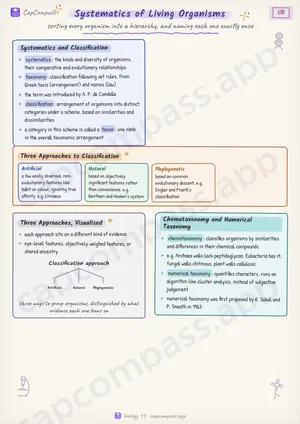
Systematics and Classification
- systematics: the kinds and diversity of organisms, their comparative and evolutionary relationships
- taxonomy: classification following set rules, from Greek taxis (arrangement) and nomos (law)
- the term was introduced by A. P. de Candolle
- classification: arrangement of organisms into distinct categories under a scheme, based on similarities and dissimilarities
- a category in this scheme is called a taxon: one rank in the overall taxonomic arrangement
Three Approaches to Classification
- Artificial: a few easily observed, non-evolutionary features like habit or colour, ignoring true affinity. e.g. Linnaeus
- Natural: based on objectively significant features rather than convenience. e.g. Bentham and Hooker's system
- Phylogenetic: based on common evolutionary descent. e.g. Engler and Prantl's classification
Three Approaches, Visualised
- each approach sits on a different kind of evidence
- eye-level features, objectively weighed features, or shared ancestry
Chemotaxonomy and Numerical Taxonomy
- chemotaxonomy: classifies organisms by similarities and differences in their chemical compounds
- e.g. Archaea walls lack peptidoglycan, Eubacteria has it; fungal walls chitinous, plant walls cellulosic
- numerical taxonomy: quantifies characters, runs an algorithm like cluster analysis, instead of subjective judgement
- numerical taxonomy was first proposed by R. Sokal and P. Sneath in 1963
Page 1 of 8. The full sheet, all 8 pages, opens free in the app.
What this Systematics of Living Organisms sheet covers
- Systematics and Classification
- Three Approaches to Classification
- Artificial
- Natural
- Phylogenetic
- Three Approaches, Visualised
- Chemotaxonomy and Numerical Taxonomy
- Cladogram and Phylogeny
- DNA Barcoding
- Three Domains of Life
- Taxonomic Hierarchy: China rose and Cobra
- China rose
- Cobra
- Taxonomic Categories
- Units of Classification
- Species
- Genus
- Family
- Order (cohort)
- Class
- Division / Phylum
- Sub-kingdom
- Kingdom
- Common names vs Scientific names
- Common (vernacular) names
- Scientific names
- Nomenclature
- Nomenclature Codes Beyond Plants
- Five Kingdom Classification
- Five Kingdoms, Salient Features
- Monera
- Protista
- Fungi
- Plantae
- Animalia
- The Five Kingdoms, Side by Side
- Two Kingdom System vs Five Kingdom System
- Two Kingdom (Linnaeus)
- Five Kingdom (Whittaker, 1969)
- Monera: General Features
- Monera: the Named Groups
- Four Classes of Fungi
- Phycomycetes
- Ascomycetes
- Basidiomycetes
- Deuteromycetes
- Viruses & Lichens
- Viruses and Lichens
- Viruses and Viroids
- Viral Diseases
- Plants
- Animals
- Humans
- DNA viruses vs RNA viruses
- DNA viruses
- RNA viruses
- Prions
- Lichens
- Symbols
- Traps that cost marks
- Tricks that save time
How CapCompass uses this sheet
These notes are not a standalone PDF. CapCompass plans Biology chapter by chapter against your real exam dates and free hours, and when the plan reaches Systematics of Living Organisms the sheet opens inside the study block itself — at the page covering the sub-topic that block is on, with the timer still running. Revision arrives at the moment the plan says revise, instead of having to be gone looking for.
More Biology Class 11 revision notes
- Animal Tissue
- Biomolecules
- Cell Division
- Cell Structure and Organization
- Excretion and Osmoregulation
- Human Nutrition
- Kingdom Animalia
- Kingdom Plantae
- Living World
- Morphology of Flowering Plants
- Photosynthesis
- Plant Tissues and Anatomy
- Respiration and Energy Transfer
- Skeleton and Movement
- Study of Animal Type: Cockroach