Cell Structure and Organization — Class 11 Maharashtra HSC Biology revision notes
A 9-page visual revision sheet for Cell Structure and Organization, written for Class 11 Maharashtra HSC Biology. Formulas, diagrams and the traps that cost marks, laid out to be read the night before rather than the term before. Free, and it opens inside CapCompass.
 Page 1 as PDF
Cell Structure and Organization in one look
prokaryotic and eukaryotic cells, and the organelles the microscope actually revealed
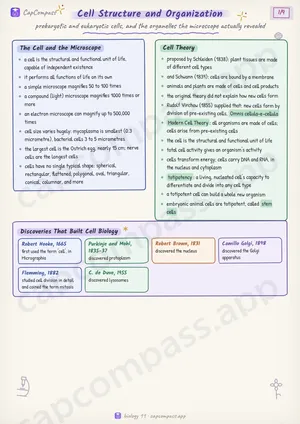
The Cell and the Microscope
- a cell is the structural and functional unit of life, capable of independent existence
- it performs all functions of life on its own
- a simple microscope magnifies 50 to 100 times
- a compound (light) microscope magnifies 1000 times or more
- an electron microscope can magnify up to 500,000 times
- cell size varies hugely: mycoplasma is smallest (0.3 micrometre), bacterial cells 3 to 5 micrometres
- the largest cell is the Ostrich egg, nearly 15 cm; nerve cells are the longest cells
- cells have no single typical shape: spherical, rectangular, flattened, polygonal, oval, triangular, conical, columnar, and more
Cell Theory
- proposed by Schleiden (1838): plant tissues are made of different cell types
- and Schwann (1839): cells are bound by a membrane
- animals and plants are made of cells and cell products
- the original theory did not explain how new cells form
- Rudolf Virchow (1855) supplied that: new cells form by division of pre-existing cells, Omnis cellula-e-cellula
- Modern Cell Theory: all organisms are made of cells; cells arise from pre-existing cells
- the cell is the structural and functional unit of life
- total cell activity gives an organism's activity
- cells transform energy; cells carry DNA and RNA, in the nucleus and cytoplasm
- totipotency: a living, nucleated cell's capacity to differentiate and divide into any cell type
- a totipotent cell can build a whole new organism
- embryonic animal cells are totipotent, called stem cells
Discoveries That Built Cell Biology
- Robert Hooke, 1665: first used the term 'cell', in Micrographia
- Purkinje and Mohl, 1835-37: discovered protoplasm
- Robert Brown, 1831: discovered the nucleus
- Camillo Golgi, 1898: discovered the Golgi apparatus
- Flemming, 1882: studied cell division in detail and coined the term mitosis
- C. de Duve, 1955: discovered lysosomes
Page 1 of 9. The full sheet, all 9 pages, opens free in the app.
What this Cell Structure and Organization sheet covers
- The Cell and the Microscope
- Cell Theory
- Discoveries That Built Cell Biology
- Robert Hooke, 1665
- Purkinje and Mohl, 1835-37
- Robert Brown, 1831
- Camillo Golgi, 1898
- Flemming, 1882
- C. de Duve, 1955
- Prokaryotic Cells
- Eukaryotic Cells
- Cell Wall
- Plasma Membrane and the Fluid Mosaic Model
- Passive vs Active Transport
- Passive transport
- Active transport
- Cytoplasm and the Endomembrane System
- Endoplasmic Reticulum (ER)
- Rough ER vs Smooth ER
- Rough ER
- Smooth ER
- Golgi Complex
- Lysosomes
- Lysosome Types
- Vacuoles and Microbodies
- Microbodies at a Glance
- Mitochondria
- Plastids
- Plastid Types
- Ribosomes
- Ribosome Subunits
- Nucleus
- Euchromatin vs Heterochromatin
- Euchromatin
- Heterochromatin
- Why the Nucleus Is Called the Master Organelle
- Cytoskeleton
- Cilia and Flagella
- Centrioles and Centrosomes
- Symbols
- Traps that cost marks
- Tricks that save time
How CapCompass uses this sheet
These notes are not a standalone PDF. CapCompass plans Biology chapter by chapter against your real exam dates and free hours, and when the plan reaches Cell Structure and Organization the sheet opens inside the study block itself — at the page covering the sub-topic that block is on, with the timer still running. Revision arrives at the moment the plan says revise, instead of having to be gone looking for.
More Biology Class 11 revision notes
- Animal Tissue
- Biomolecules
- Cell Division
- Excretion and Osmoregulation
- Human Nutrition
- Kingdom Animalia
- Kingdom Plantae
- Living World
- Morphology of Flowering Plants
- Photosynthesis
- Plant Tissues and Anatomy
- Respiration and Energy Transfer
- Skeleton and Movement
- Study of Animal Type: Cockroach
- Systematics of Living Organisms