Excretion and Osmoregulation — Class 11 Maharashtra HSC Biology revision notes
A 7-page visual revision sheet for Excretion and Osmoregulation, written for Class 11 Maharashtra HSC Biology. Formulas, diagrams and the traps that cost marks, laid out to be read the night before rather than the term before. Free, and it opens inside CapCompass.
 Page 1 as PDF
Excretion and Osmoregulation in one look
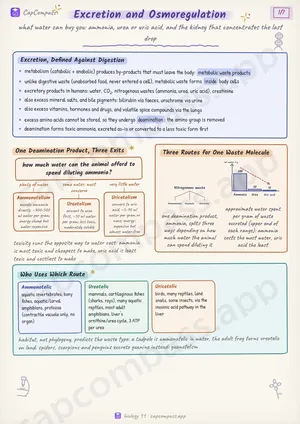
what water can buy you: ammonia, urea or uric acid, and the kidney that concentrates the last drop
Excretion, Defined Against Digestion
- metabolism (catabolic + anabolic) produces by-products that must leave the body: metabolic waste products
- unlike digestive waste (unabsorbed food, never entered a cell), metabolic waste forms inside body cells
- excretory products in humans: water, CO2, nitrogenous wastes (ammonia, urea, uric acid), creatinine
- also excess mineral salts, and bile pigments: bilirubin via faeces, urochrome via urine
- also excess vitamins, hormones and drugs, and volatile spice compounds via the lungs
- excess amino acids cannot be stored, so they undergo deamination: the amino group is removed
- deamination forms toxic ammonia, excreted as-is or converted to a less toxic form first
One Deamination Product, Three Exits
how much water can the animal afford to spend diluting ammonia?
- plenty of water — Ammonotelism: excrete ammonia directly, ~300-500 ml water per gram; energy-cheap but water-expensive
- some water, must conserve — Ureotelism: convert to urea first, ~50 ml water per gram; less toxic, moderately soluble
- very little water — Uricotelism: convert to uric acid, ~5-10 ml water per gram or none; energy-expensive but almost water-free
Who Uses Which Route
- Ammonotelic: aquatic invertebrates, bony fishes, aquatic/larval amphibians, protozoa (contractile vacuole only, no organ)
- Ureotelic: mammals, cartilaginous fishes (sharks, rays), many aquatic reptiles, most adult amphibians. liver's ornithine/urea cycle, 3 ATP per urea
- Uricotelic: birds, many reptiles, land snails, some insects, via the inosinic acid pathway in the liver
Page 1 of 7. The full sheet, all 7 pages, opens free in the app.
What this Excretion and Osmoregulation sheet covers
- Excretion, Defined Against Digestion
- One Deamination Product, Three Exits
- Three Routes for One Waste Molecule
- Who Uses Which Route
- Ammonotelic
- Ureotelic
- Uricotelic
- Osmoregulation and Salt Tolerance
- Stenohaline vs Euryhaline
- Stenohaline
- Euryhaline
- Excretory Structure, By Group
- The Kidney, Gross Anatomy
- Cortex, Medulla, and the Drainage Path
- Ureter, Bladder, Urethra
- The Nephron, Part by Part
- Cortical vs Juxtamedullary Nephrons
- Cortical
- Juxtamedullary
- Urine Formation, Three Steps
- Ultrafiltration
- Selective reabsorption
- Tubular secretion
- Each Step, In a Little More Detail
- Concentrating Urine: the Countercurrent Mechanism
- Descending vs Ascending Limb
- Descending limb
- Ascending limb
- ADH: the Water-Retention Loop
- Blood osmolarity rises
- ADH released
- Water reabsorbed
- RAAS: the Pressure-Retention Loop
- Low flow to afferent arteriole
- Angiotensin II formed
- BP and Na+ reabsorption rise
- Skin, Lungs, and Kidney Extras
- Haemodialysis vs Peritoneal Dialysis
- Haemodialysis
- Peritoneal dialysis
- Kidney and Urinary Disorders
- Kidney stones (renal calculi)
- Uremia
- Nephritis
- Renal failure
- Terms Worth Keeping Straight
- Traps that cost marks
- Tricks that save time
How CapCompass uses this sheet
These notes are not a standalone PDF. CapCompass plans Biology chapter by chapter against your real exam dates and free hours, and when the plan reaches Excretion and Osmoregulation the sheet opens inside the study block itself — at the page covering the sub-topic that block is on, with the timer still running. Revision arrives at the moment the plan says revise, instead of having to be gone looking for.
More Biology Class 11 revision notes
- Animal Tissue
- Biomolecules
- Cell Division
- Cell Structure and Organization
- Human Nutrition
- Kingdom Animalia
- Kingdom Plantae
- Living World
- Morphology of Flowering Plants
- Photosynthesis
- Plant Tissues and Anatomy
- Respiration and Energy Transfer
- Skeleton and Movement
- Study of Animal Type: Cockroach
- Systematics of Living Organisms