Study of Animal Type: Cockroach — Class 11 Maharashtra HSC Biology revision notes
A 6-page visual revision sheet for Study of Animal Type: Cockroach, written for Class 11 Maharashtra HSC Biology. Formulas, diagrams and the traps that cost marks, laid out to be read the night before rather than the term before. Free, and it opens inside CapCompass.
 Page 1 as PDF
Study of Animal Type: Cockroach in one look
Periplaneta americana as a type study: every organ system of a classic insect
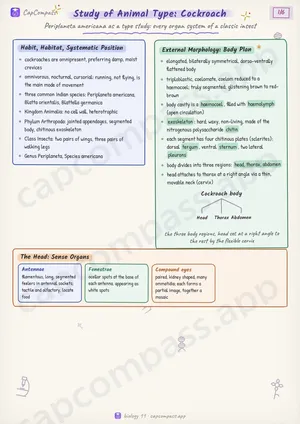
Habit, Habitat, Systematic Position
- cockroaches are omnipresent, preferring damp, moist crevices
- omnivorous, nocturnal, cursorial: running, not flying, is the main mode of movement
- three common Indian species: Periplaneta americana, Blatta orientalis, Blattella germanica
- Kingdom Animalia: no cell wall, heterotrophic
- Phylum Arthropoda: jointed appendages, segmented body, chitinous exoskeleton
- Class Insecta: two pairs of wings, three pairs of walking legs
- Genus Periplaneta, Species americana
External Morphology: Body Plan
- elongated, bilaterally symmetrical, dorso-ventrally flattened body
- triploblastic, coelomate, coelom reduced to a haemocoel; truly segmented; glistening brown to red-brown
- body cavity is a haemocoel, filled with haemolymph (open circulation)
- exoskeleton: hard, waxy, non-living, made of the nitrogenous polysaccharide chitin
- each segment has four chitinous plates (sclerites): dorsal tergum, ventral sternum, two lateral pleurons
- body divides into three regions: head, thorax, abdomen
- head attaches to thorax at a right angle via a thin, movable neck (cervix)
The Head: Sense Organs
- Antennae: filamentous, long, segmented feelers in antennal sockets; tactile and olfactory, locate food
- Fenestrae: ocellar spots at the base of each antenna, appearing as white spots
- Compound eyes: paired, kidney shaped, many ommatidia; each forms a partial image, together a mosaic
Page 1 of 6. The full sheet, all 6 pages, opens free in the app.
What this Study of Animal Type: Cockroach sheet covers
- Habit, Habitat, Systematic Position
- External Morphology: Body Plan
- The Head: Sense Organs
- Antennae
- Fenestrae
- Compound eyes
- Mouth Parts: Chewing and Biting Type
- Thorax, Legs, Wings
- Abdomen and Body Cavity
- Digestive System, Three Regions
- Salivary Glands
- Circulatory System: Open Type
- Blood Circulation, the Cycle
- Respiratory (Tracheal) System
- Excretory System
- Nervous System, Three Divisions
- Autonomous Nervous System, Four Ganglia
- Frontal ganglion
- Hypocerebral ganglion
- Ingluvial (visceral) ganglion
- Ventricular ganglion
- Compound Eye, a Closer Look
- Male vs Female Reproductive System
- Male
- Female
- Fertilisation and the Ootheca
- Interactions with Mankind
- Traps that cost marks
- Tricks that save time
How CapCompass uses this sheet
These notes are not a standalone PDF. CapCompass plans Biology chapter by chapter against your real exam dates and free hours, and when the plan reaches Study of Animal Type: Cockroach the sheet opens inside the study block itself — at the page covering the sub-topic that block is on, with the timer still running. Revision arrives at the moment the plan says revise, instead of having to be gone looking for.
More Biology Class 11 revision notes
- Animal Tissue
- Biomolecules
- Cell Division
- Cell Structure and Organization
- Excretion and Osmoregulation
- Human Nutrition
- Kingdom Animalia
- Kingdom Plantae
- Living World
- Morphology of Flowering Plants
- Photosynthesis
- Plant Tissues and Anatomy
- Respiration and Energy Transfer
- Skeleton and Movement
- Systematics of Living Organisms