Photosynthesis — Class 11 Maharashtra HSC Biology revision notes
A 6-page visual revision sheet for Photosynthesis, written for Class 11 Maharashtra HSC Biology. Formulas, diagrams and the traps that cost marks, laid out to be read the night before rather than the term before. Free, and it opens inside CapCompass.
 Page 1 as PDF
Photosynthesis in one look
trapping solar energy in chlorophyll: the light reaction, the Calvin cycle, and the C4/CAM shortcuts
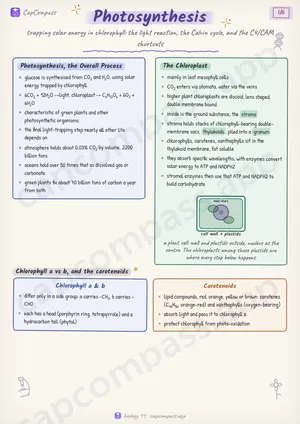
Photosynthesis, the Overall Process
- glucose is synthesised from CO2 and H2O, using solar energy trapped by chlorophyll
- 6CO2 + 12H2O --light, chloroplast--> C6H12O6 + 6O2 + 6H2O
- characteristic of green plants and other photosynthetic organisms
- the final light-trapping step nearly all other life depends on
- atmosphere holds about 0.03% CO2 by volume, 2200 billion tons
- oceans hold over 50 times that as dissolved gas or carbonate
- green plants fix about 70 billion tons of carbon a year from both
The Chloroplast
- mainly in leaf mesophyll cells
- CO2 enters via stomata, water via the veins
- higher plant chloroplasts are discoid, lens shaped, double membrane bound
- inside is the ground substance, the stroma
- stroma holds stacks of chlorophyll-bearing double-membrane sacs, thylakoids, piled into a granum
- chlorophylls, carotenes, xanthophylls sit in the thylakoid membrane, fat soluble
- they absorb specific wavelengths, with enzymes convert solar energy to ATP and NADPH2
- stromal enzymes then use that ATP and NADPH2 to build carbohydrate
Chlorophyll a vs b, and the carotenoids
- differ only in a side group: a carries -CH3, b carries -CHO
- each has a head (porphyrin ring, tetrapyrrole) and a hydrocarbon tail (phytol)
- lipid compounds, red, orange, yellow or brown: carotenes (C40H56, orange-red) and xanthophylls (oxygen-bearing)
- absorb light and pass it to chlorophyll a
- protect chlorophyll from photo-oxidation
Page 1 of 6. The full sheet, all 6 pages, opens free in the app.
What this Photosynthesis sheet covers
- Photosynthesis, the Overall Process
- The Chloroplast
- Chlorophyll a vs b, and the carotenoids
- Chlorophyll a & b
- Carotenoids
- Light, Absorption Spectrum, Action Spectrum
- Proving Where the Oxygen Comes From
- Light Reaction vs Dark Reaction
- Light Reaction: Photosystems
- PS-II: Photolysis of Water
- PS-I: Making NADPH2
- Cyclic vs Non-cyclic Photophosphorylation
- Cyclic
- Non-cyclic
- Dark Reaction: the Calvin Cycle (C3 pathway)
- Full Reaction, Light + Dark
- Light reaction (granum)
- Dark reaction (stroma)
- Net
- Photorespiration (PCO Cycle)
- C3 vs C4 Plants
- C3 plants
- C4 plants
- The C4 (Hatch-Slack) Pathway
- CAM (Crassulacean Acid Metabolism)
- Factors Affecting the Rate of Photosynthesis
- Blackman's Law of Limiting Factors
- Traps that cost marks
- Tricks that save time
How CapCompass uses this sheet
These notes are not a standalone PDF. CapCompass plans Biology chapter by chapter against your real exam dates and free hours, and when the plan reaches Photosynthesis the sheet opens inside the study block itself — at the page covering the sub-topic that block is on, with the timer still running. Revision arrives at the moment the plan says revise, instead of having to be gone looking for.
More Biology Class 11 revision notes
- Animal Tissue
- Biomolecules
- Cell Division
- Cell Structure and Organization
- Excretion and Osmoregulation
- Human Nutrition
- Kingdom Animalia
- Kingdom Plantae
- Living World
- Morphology of Flowering Plants
- Plant Tissues and Anatomy
- Respiration and Energy Transfer
- Skeleton and Movement
- Study of Animal Type: Cockroach
- Systematics of Living Organisms