Skeleton and Movement — Class 11 Maharashtra HSC Biology revision notes
A 6-page visual revision sheet for Skeleton and Movement, written for Class 11 Maharashtra HSC Biology. Formulas, diagrams and the traps that cost marks, laid out to be read the night before rather than the term before. Free, and it opens inside CapCompass.
 Page 1 as PDF
Skeleton and Movement in one look
206 bones, three muscle types, and the sliding filaments that turn a chemical signal into a pull
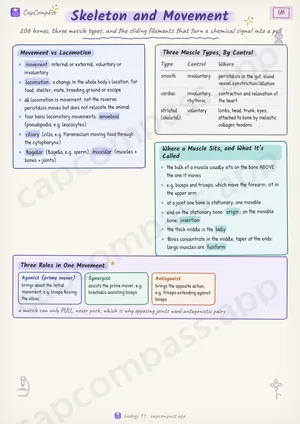
Movement vs Locomotion
- movement: internal or external, voluntary or involuntary
- locomotion: a change in the whole body's location, for food, shelter, mate, breeding ground or escape
- all locomotion is movement, not the reverse: peristalsis moves but does not relocate the animal
- four basic locomotory movements: amoeboid (pseudopodia, e.g. leucocytes)
- ciliary (cilia, e.g. Paramecium moving food through the cytopharynx)
- flagellar (flagella, e.g. sperm), muscular (muscles + bones + joints)
Three Muscle Types, By Control
| Type | Control | Where |
|---|---|---|
| smooth | involuntary | peristalsis in the gut, blood vessel constriction/dilation |
| cardiac | involuntary, rhythmic | contraction and relaxation of the heart |
| striated (skeletal) | voluntary | limbs, head, trunk, eyes; attached to bone by inelastic collagen tendons |
Where a Muscle Sits, and What It's Called
- the bulk of a muscle usually sits on the bone ABOVE the one it moves
- e.g. biceps and triceps, which move the forearm, sit in the upper arm
- at a joint one bone is stationary, one movable
- end on the stationary bone: origin; on the movable bone: insertion
- the thick middle is the belly
- fibres concentrate in the middle, taper at the ends: large muscles are fusiform
Three Roles in One Movement
- Agonist (prime mover): brings about the initial movement, e.g. biceps flexing the elbow
- Synergist: assists the prime mover, e.g. brachialis assisting biceps
- Antagonist: brings the opposite action, e.g. triceps extending against biceps
Page 1 of 6. The full sheet, all 6 pages, opens free in the app.
What this Skeleton and Movement sheet covers
- Movement vs Locomotion
- Three Muscle Types, By Control
- Where a Muscle Sits, and What It's Called
- Three Roles in One Movement
- Agonist (prime mover)
- Synergist
- Antagonist
- Antagonistic Pairs, Named
- Myosin and Actin, the Two Filaments
- Sliding Filament Theory
- Mechanism of Contraction
- Ca2+ released
- Active sites exposed
- Actomyosin forms, slides
- Relaxation Is Active Too
- Properties Under Electrical Stimulation
- Oxygen Debt and Rigor Mortis
- Bone, Cartilage and the Lever Analogy
- Three Classes of Lever, In the Body
- Class I
- Class II
- Class III
- The 206-Bone Plan
- Where the 206 Bones Are
- Vertebral Column
- Thoracic Cage and Ribs
- Joints, By Movement Allowed
- Six Kinds of Synovial Joint
- Muscle, Bone and Joint Disorders
- Traps that cost marks
- Tricks that save time
How CapCompass uses this sheet
These notes are not a standalone PDF. CapCompass plans Biology chapter by chapter against your real exam dates and free hours, and when the plan reaches Skeleton and Movement the sheet opens inside the study block itself — at the page covering the sub-topic that block is on, with the timer still running. Revision arrives at the moment the plan says revise, instead of having to be gone looking for.
More Biology Class 11 revision notes
- Animal Tissue
- Biomolecules
- Cell Division
- Cell Structure and Organization
- Excretion and Osmoregulation
- Human Nutrition
- Kingdom Animalia
- Kingdom Plantae
- Living World
- Morphology of Flowering Plants
- Photosynthesis
- Plant Tissues and Anatomy
- Respiration and Energy Transfer
- Study of Animal Type: Cockroach
- Systematics of Living Organisms