Cell Division — Class 11 Maharashtra HSC Biology revision notes
A 6-page visual revision sheet for Cell Division, written for Class 11 Maharashtra HSC Biology. Formulas, diagrams and the traps that cost marks, laid out to be read the night before rather than the term before. Free, and it opens inside CapCompass.
 Page 1 as PDF
Cell Division in one look
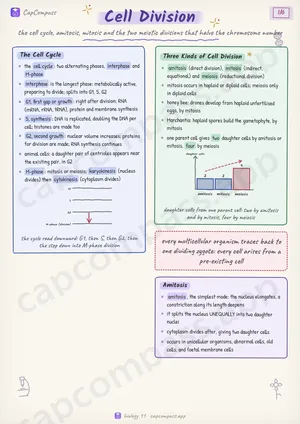
the cell cycle, amitosis, mitosis and the two meiotic divisions that halve the chromosome number
The Cell Cycle
- the cell cycle: two alternating phases, interphase and M-phase
- interphase is the longest phase: metabolically active, preparing to divide; splits into G1, S, G2
- G1, first gap or growth: right after division; RNA (mRNA, rRNA, tRNA), protein and membrane synthesis
- S, synthesis: DNA is replicated, doubling the DNA per cell; histones are made too
- G2, second growth: nuclear volume increases; proteins for division are made; RNA synthesis continues
- animal cells: a daughter pair of centrioles appears near the existing pair, in G2
- M-phase: mitosis or meiosis; karyokinesis (nucleus divides) then cytokinesis (cytoplasm divides)
Three Kinds of Cell Division
- amitosis (direct division), mitosis (indirect, equational) and meiosis (reductional division)
- mitosis occurs in haploid or diploid cells; meiosis only in diploid cells
- honey bee: drones develop from haploid unfertilised eggs, by mitosis
- Marchantia: haploid spores build the gametophyte, by mitosis
- one parent cell gives two daughter cells by amitosis or mitosis, four by meiosis
Amitosis
- amitosis, the simplest mode: the nucleus elongates, a constriction along its length deepens
- it splits the nucleus UNEQUALLY into two daughter nuclei
- cytoplasm divides after, giving two daughter cells
- occurs in unicellular organisms, abnormal cells, old cells, and foetal membrane cells
Page 1 of 6. The full sheet, all 6 pages, opens free in the app.
What this Cell Division sheet covers
- The Cell Cycle
- Three Kinds of Cell Division
- Amitosis
- Mitosis: What It Does
- Mitosis, Stage by Stage
- Mitosis Order
- Cytokinesis, Animal vs Plant
- Animal cell
- Plant cell
- Significance of Mitosis
- Meiosis: Overview
- Prophase-I: the Five Sub-Stages
- Prophase-I, Sub-Stage by Sub-Stage
- Meiosis I, Metaphase to Cytokinesis
- Meiosis II, Stage by Stage
- Why Meiosis II Is Called Homotypic
- Significance of Meiosis
- Cell Death: Necrosis vs Apoptosis
- Necrosis
- Apoptosis
- Mitosis vs Meiosis
- Mitosis
- Meiosis
- Symbols
- Traps that cost marks
- Tricks that save time
How CapCompass uses this sheet
These notes are not a standalone PDF. CapCompass plans Biology chapter by chapter against your real exam dates and free hours, and when the plan reaches Cell Division the sheet opens inside the study block itself — at the page covering the sub-topic that block is on, with the timer still running. Revision arrives at the moment the plan says revise, instead of having to be gone looking for.
More Biology Class 11 revision notes
- Animal Tissue
- Biomolecules
- Cell Structure and Organization
- Excretion and Osmoregulation
- Human Nutrition
- Kingdom Animalia
- Kingdom Plantae
- Living World
- Morphology of Flowering Plants
- Photosynthesis
- Plant Tissues and Anatomy
- Respiration and Energy Transfer
- Skeleton and Movement
- Study of Animal Type: Cockroach
- Systematics of Living Organisms