Plant Tissues and Anatomy — Class 11 Maharashtra HSC Biology revision notes
A 6-page visual revision sheet for Plant Tissues and Anatomy, written for Class 11 Maharashtra HSC Biology. Formulas, diagrams and the traps that cost marks, laid out to be read the night before rather than the term before. Free, and it opens inside CapCompass.
 Page 1 as PDF
Plant Tissues and Anatomy in one look
meristematic and permanent tissue, the three tissue systems, and the anatomy of root, stem and leaf
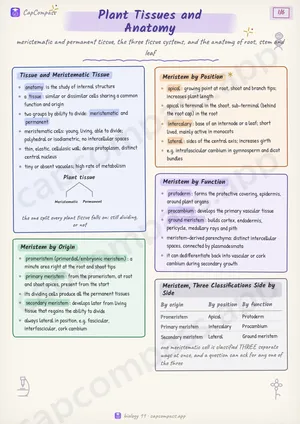
Tissue and Meristematic Tissue
- anatomy is the study of internal structure
- a tissue: similar or dissimilar cells sharing a common function and origin
- two groups by ability to divide: meristematic and permanent
- meristematic cells: young, living, able to divide; polyhedral or isodiametric, no intercellular spaces
- thin, elastic, cellulosic wall; dense protoplasm, distinct central nucleus
- tiny or absent vacuoles; high rate of metabolism
Meristem by Origin
- promeristem (primordial/embryonic meristem): a minute area right at the root and shoot tips
- primary meristem: from the promeristem, at root and shoot apices, present from the start
- its dividing cells produce all the permanent tissues
- secondary meristem: develops later from living tissue that regains the ability to divide
- always lateral in position, e.g. fascicular, interfascicular, cork cambium
Meristem by Position
- apical: growing point at root, shoot and branch tips; increases plant length
- apical is terminal in the shoot, sub-terminal (behind the root cap) in the root
- intercalary: base of an internode or a leaf; short lived, mainly active in monocots
- lateral: sides of the central axis; increases girth
- e.g. intrafascicular cambium in gymnosperm and dicot bundles
Meristem by Function
- protoderm: forms the protective covering, epidermis, around plant organs
- procambium: develops the primary vascular tissue
- ground meristem: builds cortex, endodermis, pericycle, medullary rays and pith
- meristem-derived parenchyma: distinct intercellular spaces, connected by plasmodesmata
- it can dedifferentiate back into vascular or cork cambium during secondary growth
Meristem, Three Classifications Side by Side
| By origin | By position | By function |
|---|---|---|
| Promeristem | Apical | Protoderm |
| Primary meristem | Intercalary | Procambium |
| Secondary meristem | Lateral | Ground meristem |
Page 1 of 6. The full sheet, all 6 pages, opens free in the app.
What this Plant Tissues and Anatomy sheet covers
- Tissue and Meristematic Tissue
- Meristem by Origin
- Meristem by Position
- Meristem by Function
- Meristem, Three Classifications Side by Side
- Permanent Tissue: Parenchyma and Collenchyma
- Permanent Tissue: Sclerenchyma
- Complex Tissue: Xylem Cells
- Xylem Thickening Patterns
- Phloem: Sieve Tubes and Companion Cells
- Phloem: the Other Cells
- Epidermal Tissue System
- Ground and Vascular Tissue Systems
- Vascular Bundle Types
- Secondary Growth: the Cambial Ring
- Spring Wood, Autumn Wood, Heartwood, Sapwood
- Cork Cambium and the Periderm
- Anomalous Secondary Growth
- Anatomy of Dicot Root
- Monocot Root
- Anatomy of Dicot Stem (Sunflower)
- Anatomy of Monocot Stem
- Dorsiventral (Dicot) Leaf
- Isobilateral (Monocot) Leaf
- Traps that cost marks
- Tricks that save time
How CapCompass uses this sheet
These notes are not a standalone PDF. CapCompass plans Biology chapter by chapter against your real exam dates and free hours, and when the plan reaches Plant Tissues and Anatomy the sheet opens inside the study block itself — at the page covering the sub-topic that block is on, with the timer still running. Revision arrives at the moment the plan says revise, instead of having to be gone looking for.
More Biology Class 11 revision notes
- Animal Tissue
- Biomolecules
- Cell Division
- Cell Structure and Organization
- Excretion and Osmoregulation
- Human Nutrition
- Kingdom Animalia
- Kingdom Plantae
- Living World
- Morphology of Flowering Plants
- Photosynthesis
- Respiration and Energy Transfer
- Skeleton and Movement
- Study of Animal Type: Cockroach
- Systematics of Living Organisms