Ray Optics and Optical Instruments — Class 12 CBSE Physics revision notes
A 8-page visual revision sheet for Ray Optics and Optical Instruments, written for Class 12 CBSE Physics. Formulas, diagrams and the traps that cost marks, laid out to be read the night before rather than the term before. Free, and it opens inside CapCompass.
 Page 1 as PDF
Ray Optics and Optical Instruments in one look
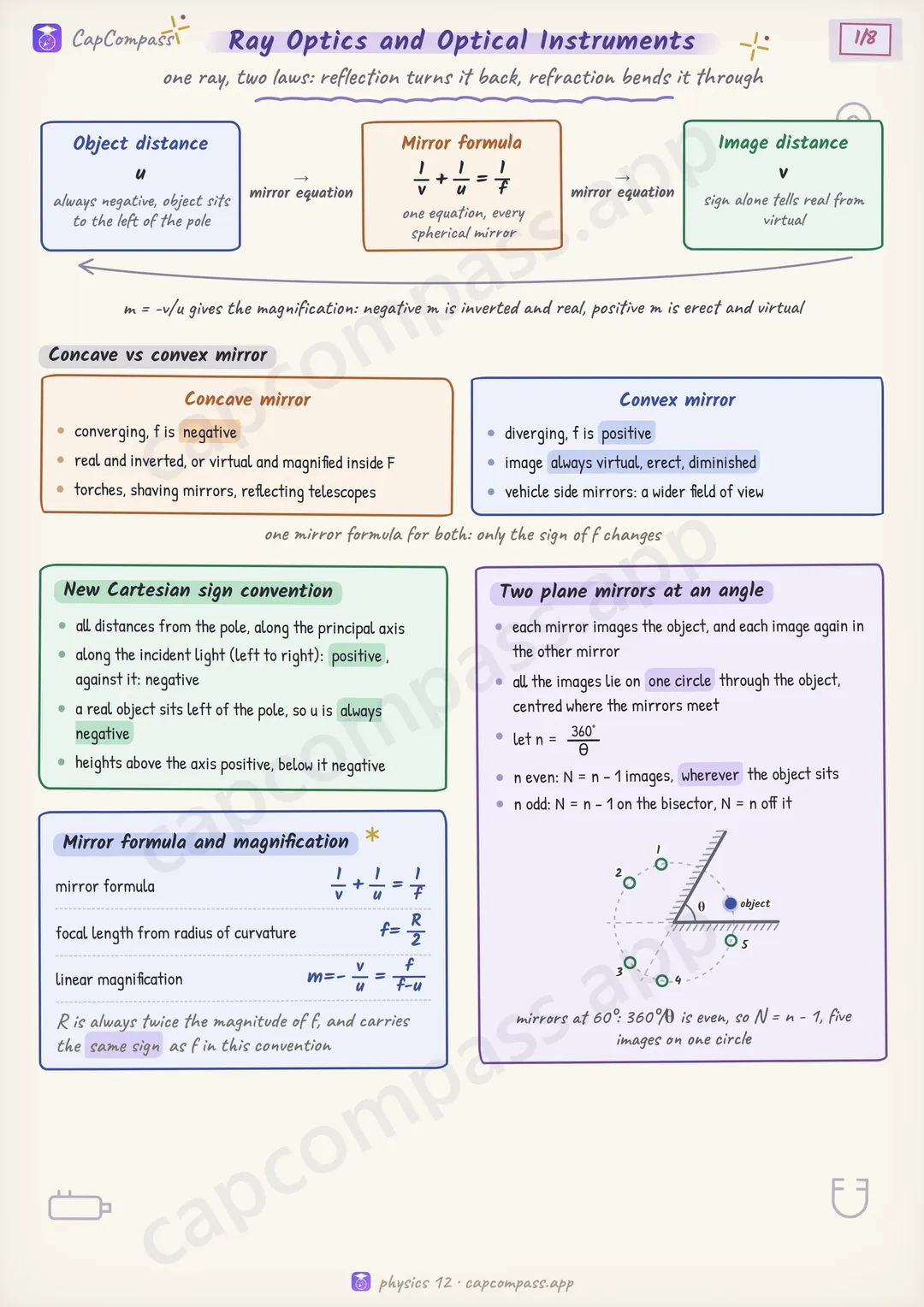
one ray, two laws: reflection turns it back, refraction bends it through
- Object distance: always negative, object sits to the left of the pole
- Mirror formula: one equation, every spherical mirror
- Image distance: sign alone tells real from virtual
Concave vs convex mirror
- converging, f is negative
- real and inverted, or virtual and magnified inside F
- torches, shaving mirrors, reflecting telescopes
- diverging, f is positive
- image always virtual, erect, diminished
- vehicle side mirrors: a wider field of view
New Cartesian sign convention
- all distances from the pole, along the principal axis
- along the incident light (left to right): positive, against it: negative
- a real object sits left of the pole, so u is always negative
- heights above the axis positive, below it negative
Mirror formula and magnification
- mirror formula
1/v+1/u=1/f - focal length from radius of curvature
f=R/2 - linear magnification
m=-v/u=f/f-u
Two plane mirrors at an angle
- each mirror images the object, and each image again in the other mirror
- all the images lie on one circle through the object, centred where the mirrors meet
- let n = 360°/θ
- n even: N = n - 1 images, wherever the object sits
- n odd: N = n - 1 on the bisector, N = n off it
Page 1 of 8. The full sheet, all 8 pages, opens free in the app.
What this Ray Optics and Optical Instruments sheet covers
- Object distance
- Mirror formula
- Image distance
- Concave vs convex mirror
- Concave mirror
- Convex mirror
- New Cartesian sign convention
- Mirror formula and magnification
- focal length from radius of curvature
- linear magnification
- Two plane mirrors at an angle
- Mirror ray diagrams, drawn from the mirror formula
- Spherical aberration
- Refraction and total internal reflection
- Snell's law
- absolute refractive index
- critical angle, denser medium of index n
- Real and apparent depth
- In the lab: travelling microscope
- Where TIR shows up
- Optical fibre and mirage
- Lenses
- thin lens formula
- lensmaker's formula
- magnification
- power of a lens, f in metres
- lenses in contact
- Convex lens: the limiting cases
- Lens ray diagrams, drawn from the lens formula
- In the lab: optical bench
- Prism and dispersion
- angle of the prism
- deviation
- at minimum deviation, i = e, r_1 = r_2 = A/2
- In the lab: minimum deviation
- Two prisms: crown and flint
- thin prism of angle A: deviation
- its angular dispersion, violet to red
- no dispersion, flint turned over
- no deviation of the mean colour
- Chromatic aberration and the achromatic doublet
- Optical instruments
- simple microscope, image at the near point
- compound microscope, normal adjustment
- astronomical telescope, normal adjustment
- telescope tube, normal adjustment
- Symbols
- Combinations: lenses, lens and mirror, silvered lens
- Traps that cost marks
- Tricks that save time
How CapCompass uses this sheet
These notes are not a standalone PDF. CapCompass plans Physics chapter by chapter against your real exam dates and free hours, and when the plan reaches Ray Optics and Optical Instruments the sheet opens inside the study block itself — at the page covering the sub-topic that block is on, with the timer still running. Revision arrives at the moment the plan says revise, instead of having to be gone looking for.