Adsorption and Colloids — Class 11 Maharashtra HSC Chemistry revision notes
A 6-page visual revision sheet for Adsorption and Colloids, written for Class 11 Maharashtra HSC Chemistry. Formulas, diagrams and the traps that cost marks, laid out to be read the night before rather than the term before. Free, and it opens inside CapCompass.
 Page 1 as PDF
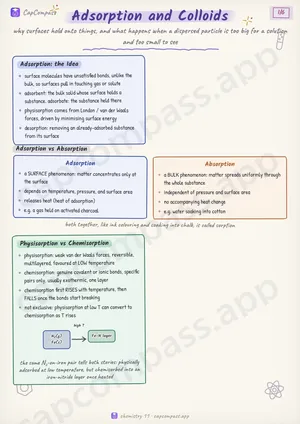
Adsorption and Colloids in one look
why surfaces hold onto things, and what happens when a dispersed particle is too big for a solution and too small to see
Adsorption: the Idea
- surface molecules have unsatisfied bonds, unlike the bulk, so surfaces pull in touching gas or solute
- adsorbent: the bulk solid whose surface holds a substance. adsorbate: the substance held there
- physisorption comes from London / van der Waals forces, driven by minimising surface energy
- desorption: removing an already-adsorbed substance from its surface
Adsorption vs Absorption
- a SURFACE phenomenon: matter concentrates only at the surface
- depends on temperature, pressure, and surface area
- releases heat (heat of adsorption)
- e.g. a gas held on activated charcoal
- a BULK phenomenon: matter spreads uniformly through the whole substance
- independent of pressure and surface area
- no accompanying heat change
- e.g. water soaking into cotton
Physisorption vs Chemisorption
- physisorption: weak van der Waals forces, reversible, multilayered, favoured at LOW temperature
- chemisorption: genuine covalent or ionic bonds, specific pairs only, usually exothermic, one layer
- chemisorption first RISES with temperature, then FALLS once the bonds start breaking
- not exclusive: physisorption at low T can convert to chemisorption as T rises
Page 1 of 6. The full sheet, all 6 pages, opens free in the app.
What this Adsorption and Colloids sheet covers
- Adsorption: the Idea
- Adsorption vs Absorption
- Adsorption
- Absorption
- Physisorption vs Chemisorption
- Physisorption vs Chemisorption, by the Numbers
- What Controls How Much Gets Adsorbed
- The Freundlich Adsorption Isotherm
- Applications of Adsorption
- Catalysis: Homogeneous and Heterogeneous
- Inhibitors and Catalyst Selectivity
- The Catalytic Cycle at a Solid Surface
- Diffusion
- Reaction
- Desorption
- Colloids: Between a Solution and a Suspension
- Colloid Types by Physical State
- Classifying Colloids: Affinity and Size
- Micelles: How Soap Actually Works
- Preparing Colloids
- Purifying a Colloidal Solution: Dialysis
- Optical and Kinetic Properties
- Electrical Properties and Coagulation
- Emulsions
- Applications of Colloids
- Traps that cost marks
- Tricks that save time
How CapCompass uses this sheet
These notes are not a standalone PDF. CapCompass plans Chemistry chapter by chapter against your real exam dates and free hours, and when the plan reaches Adsorption and Colloids the sheet opens inside the study block itself — at the page covering the sub-topic that block is on, with the timer still running. Revision arrives at the moment the plan says revise, instead of having to be gone looking for.
More Chemistry Class 11 revision notes
- Basic Principles of Organic Chemistry
- Chemical Bonding
- Chemical Equilibrium
- Chemistry in Everyday Life
- Elements of Group 1 and 2
- Elements of Group 13, 14 and 15
- Hydrocarbons
- Introduction to Analytical Chemistry
- Modern Periodic Table
- Nuclear Chemistry and Radioactivity
- Redox Reactions
- Some Analytical Techniques
- Some Basic Concepts of Chemistry
- States of Matter
- Structure of Atom