Chemistry in Everyday Life — Class 11 Maharashtra HSC Chemistry revision notes
A 5-page visual revision sheet for Chemistry in Everyday Life, written for Class 11 Maharashtra HSC Chemistry. Formulas, diagrams and the traps that cost marks, laid out to be read the night before rather than the term before. Free, and it opens inside CapCompass.
 Page 1 as PDF
Chemistry in Everyday Life in one look
food, medicine and cleansing agents, read as ordinary organic chemistry
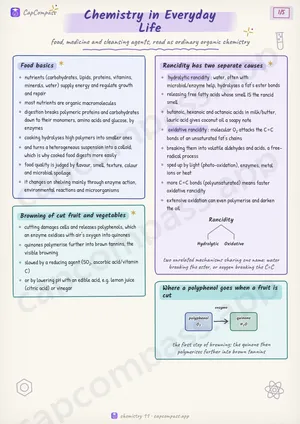
Food basics
- nutrients (carbohydrates, lipids, proteins, vitamins, minerals, water) supply energy and regulate growth and repair
- most nutrients are organic macromolecules
- digestion breaks polymeric proteins and carbohydrates down to their monomers, amino acids and glucose, by enzymes
- cooking hydrolyses high polymers into smaller ones
- and turns a heterogeneous suspension into a colloid, which is why cooked food digests more easily
- food quality is judged by flavour, smell, texture, colour and microbial spoilage
- it changes on shelving mainly through enzyme action, environmental reactions and microorganisms
Browning of cut fruit and vegetables
- cutting damages cells and releases polyphenols, which an enzyme oxidises with air's oxygen into quinones
- quinones polymerise further into brown tannins, the visible browning
- slowed by a reducing agent (SO_2, ascorbic acid/vitamin C)
- or by lowering pH with an edible acid, e.g. lemon juice (citric acid) or vinegar
Rancidity has two separate causes
- hydrolytic rancidity: water, often with microbial/enzyme help, hydrolyses a fat's ester bonds
- releasing free fatty acids whose smell IS the rancid smell
- butanoic, hexanoic and octanoic acids in milk/butter, lauric acid gives coconut oil a soapy note
- oxidative rancidity: molecular O_2 attacks the C=C bonds of an unsaturated fat's chains
- breaking them into volatile aldehydes and acids, a free-radical process
- sped up by light (photo-oxidation), enzymes, metal ions or heat
- more C=C bonds (polyunsaturated) means faster oxidative rancidity
- extensive oxidation can even polymerise and darken the oil
Page 1 of 5. The full sheet, all 5 pages, opens free in the app.
What this Chemistry in Everyday Life sheet covers
- Food basics
- Browning of cut fruit and vegetables
- Rancidity has two separate causes
- Where a polyphenol goes when a fruit is cut
- Saturated, unsaturated and trans fats
- Natural fats, by how saturated they are
- Omega-3 and antioxidants as additives
- Analgesics and antipyretics
- Antimicrobial, by where it's used
- Antiseptics and disinfectants in use
- How antibiotics were found
- Antibiotic spectrum
- Traditional plant sources of active ingredients
- Soap: making it and why it fails in hard water
- Synthetic detergents, by head group
- How a micelle actually lifts dirt
- Things to remember before the traps
- Traps that cost marks
- Tricks that save time
How CapCompass uses this sheet
These notes are not a standalone PDF. CapCompass plans Chemistry chapter by chapter against your real exam dates and free hours, and when the plan reaches Chemistry in Everyday Life the sheet opens inside the study block itself — at the page covering the sub-topic that block is on, with the timer still running. Revision arrives at the moment the plan says revise, instead of having to be gone looking for.
More Chemistry Class 11 revision notes
- Adsorption and Colloids
- Basic Principles of Organic Chemistry
- Chemical Bonding
- Chemical Equilibrium
- Elements of Group 1 and 2
- Elements of Group 13, 14 and 15
- Hydrocarbons
- Introduction to Analytical Chemistry
- Modern Periodic Table
- Nuclear Chemistry and Radioactivity
- Redox Reactions
- Some Analytical Techniques
- Some Basic Concepts of Chemistry
- States of Matter
- Structure of Atom