Nuclear Chemistry and Radioactivity — Class 11 Maharashtra HSC Chemistry revision notes
A 6-page visual revision sheet for Nuclear Chemistry and Radioactivity, written for Class 11 Maharashtra HSC Chemistry. Formulas, diagrams and the traps that cost marks, laid out to be read the night before rather than the term before. Free, and it opens inside CapCompass.
 Page 1 as PDF
Nuclear Chemistry and Radioactivity in one look
what holds a nucleus together, what makes some fall apart, and how fast they do it
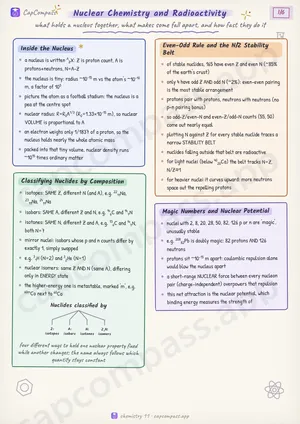
Inside the Nucleus
- a nucleus is written ^A_ZX: Z is proton count, A is protons+neutrons, N=A-Z
- the nucleus is tiny: radius ~10^-15 m vs the atom's ~10^-10 m, a factor of 10^5
- picture the atom as a football stadium: the nucleus is a pea at the centre spot
- nuclear radius: R=R_0A^1/3 (R_0=1.33×10^-15 m), so nuclear VOLUME is proportional to A
- an electron weighs only 1/1837 of a proton, so the nucleus holds nearly the whole atomic mass
- packed into that tiny volume, nuclear density runs ~10^15 times ordinary matter
Classifying Nuclides by Composition
- isotopes: SAME Z, different N (and A), e.g. ^22_11Na, ^23_11Na, ^24_11Na
- isobars: SAME A, different Z and N, e.g. ^14_6C and ^14_7N
- isotones: SAME N, different Z and A, e.g. ^13_6C and ^14_7N, both N=7
- mirror nuclei: isobars whose p and n counts differ by exactly 1, simply swapped
- e.g. ^3_1H (N=2) and ^3_2He (N=1)
- nuclear isomers: same Z AND N (same A), differing only in ENERGY state
- the higher-energy one is metastable, marked 'm', e.g. ^60mCo next to ^60Co
Even-Odd Rule and the N/Z Stability Belt
- of stable nuclides, 165 have even Z and even N (~85% of the earth's crust)
- only 4 have odd Z AND odd N (~2%): even-even pairing is the most stable arrangement
- protons pair with protons, neutrons with neutrons (no p-n pairing bonus)
- so odd-Z/even-N and even-Z/odd-N counts (55, 50) come out nearly equal
- plotting N against Z for every stable nuclide traces a narrow STABILITY BELT
- nuclides falling outside that belt are radioactive
- for light nuclei (below ^40_20Ca) the belt tracks N=Z, N/Z≈1
- for heavier nuclei it curves upward: more neutrons space out the repelling protons
Magic Numbers and Nuclear Potential
- nuclei with 2, 8, 20, 28, 50, 82, 126 p or n are 'magic', unusually stable
- e.g. ^208_82Pb is doubly magic: 82 protons AND 126 neutrons
- protons sit ~10^-15 m apart: coulombic repulsion alone would blow the nucleus apart
- a short-range NUCLEAR force between every nucleon pair (charge-independent) overpowers that repulsion
- this net attraction is the nuclear potential, which binding energy measures the strength of
Page 1 of 6. The full sheet, all 6 pages, opens free in the app.
What this Nuclear Chemistry and Radioactivity sheet covers
- Inside the Nucleus
- Classifying Nuclides by Composition
- Even-Odd Rule and the N/Z Stability Belt
- Magic Numbers and Nuclear Potential
- Mass Defect and Binding Energy
- Worked: binding energy per nucleon of oxygen-16
- Reading the Binding-Energy Curve
- Radioactive Decay: the Rate Law
- The Decay Law
- number of undecayed nuclei remaining at time t
- the same relation, in base-10 logs, the form used to find λ from data
- Worked: half-life from an activity drop
- Half-Life: What It Means
- Worked: percentage remaining after a given time
- Units of Radioactivity
- Modes of Decay: Alpha, Beta, Gamma
- Worked: counting alpha and beta particles in a decay chain
- Chemical Reactions vs Nuclear Reactions
- Chemical
- Nuclear
- Transmutation and Artificial Radioactivity
- Nuclear Fission
- Nuclear Fusion
- Radiocarbon Dating
- The Nuclear Reactor
- Applications in Medicine
- Traps that cost marks
- Tricks that save time
How CapCompass uses this sheet
These notes are not a standalone PDF. CapCompass plans Chemistry chapter by chapter against your real exam dates and free hours, and when the plan reaches Nuclear Chemistry and Radioactivity the sheet opens inside the study block itself — at the page covering the sub-topic that block is on, with the timer still running. Revision arrives at the moment the plan says revise, instead of having to be gone looking for.
More Chemistry Class 11 revision notes
- Adsorption and Colloids
- Basic Principles of Organic Chemistry
- Chemical Bonding
- Chemical Equilibrium
- Chemistry in Everyday Life
- Elements of Group 1 and 2
- Elements of Group 13, 14 and 15
- Hydrocarbons
- Introduction to Analytical Chemistry
- Modern Periodic Table
- Redox Reactions
- Some Analytical Techniques
- Some Basic Concepts of Chemistry
- States of Matter
- Structure of Atom