Chemical Bonding — Class 11 Maharashtra HSC Chemistry revision notes
A 7-page visual revision sheet for Chemical Bonding, written for Class 11 Maharashtra HSC Chemistry. Formulas, diagrams and the traps that cost marks, laid out to be read the night before rather than the term before. Free, and it opens inside CapCompass.
 Page 1 as PDF
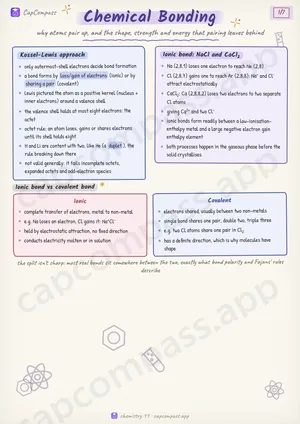
Chemical Bonding in one look
why atoms pair up, and the shape, strength and energy that pairing leaves behind
Kossel-Lewis approach
- only outermost-shell electrons decide bond formation
- a bond forms by loss/gain of electrons (ionic) or by sharing a pair (covalent)
- Lewis pictured the atom as a positive kernel (nucleus + inner electrons) around a valence shell
- the valence shell holds at most eight electrons: the octet
- octet rule: an atom loses, gains or shares electrons until its shell holds eight
- H and Li are content with two, like He (a duplet), the rule breaking down there
- not valid generally: it fails incomplete octets, expanded octets and odd-electron species
Ionic bond: NaCl and CaCl2
- Na (2,8,1) loses one electron to reach Ne (2,8)
- Cl (2,8,7) gains one to reach Ar (2,8,8): Na^+ and Cl^- attract electrostatically
- CaCl_2: Ca (2,8,8,2) loses two electrons to two separate Cl atoms
- giving Ca^2+ and two Cl^-
- ionic bonds form readily between a low-ionisation-enthalpy metal and a large negative electron gain enthalpy element
- both processes happen in the gaseous phase before the solid crystallises
Ionic bond vs covalent bond
- complete transfer of electrons, metal to non-metal
- e.g. Na loses an electron, Cl gains it: Na^+Cl^-
- held by electrostatic attraction, no fixed direction
- conducts electricity molten or in solution
- electrons shared, usually between two non-metals
- single bond shares one pair, double two, triple three
- e.g. two Cl atoms share one pair in Cl_2
- has a definite direction, which is why molecules have shape
Page 1 of 7. The full sheet, all 7 pages, opens free in the app.
What this Chemical Bonding sheet covers
- Kossel-Lewis approach
- Ionic bond: NaCl and CaCl2
- Ionic bond vs covalent bond
- Ionic
- Covalent
- Ionic solids and lattice enthalpy
- Lattice enthalpy, some values
- Covalent bond and Lewis structures
- Formal charge
- formal charge on an atom in a Lewis structure
- CO, structure C≡O: formal charge on C
- Limitations of the octet rule
- VSEPR: predicting shape from repulsion
- VSEPR shapes, by lone pair count
- Valence bond theory
- Hybridisation
- Worked: BeCl2, why hybridise at all
- Molecular orbital theory
- Bond order from MO theory
- bond order
- H_2, config σ1s^2: 2 bonding, 0 antibonding
- N_2, config through σ2p_z^2: 10 bonding, 4 antibonding
- O_2, two electrons singly fill π^*: 10 bonding, 6 antibonding
- F_2, config through π^*2p^4: 10 bonding, 8 antibonding
- Reading a bond order
- O2's paramagnetism
- Bond parameters
- bond length, H-Cl
- bond angle, H-O-H
- bond enthalpy of H_2 (dissociation energy, since H_2 is diatomic)
- average O-H bond enthalpy in H_2O, from two unequal successive steps
- Dipole moment
- Fajans' rules: covalent character in an ionic bond
- Resonance
- Traps that cost marks
- Tricks that save time
How CapCompass uses this sheet
These notes are not a standalone PDF. CapCompass plans Chemistry chapter by chapter against your real exam dates and free hours, and when the plan reaches Chemical Bonding the sheet opens inside the study block itself — at the page covering the sub-topic that block is on, with the timer still running. Revision arrives at the moment the plan says revise, instead of having to be gone looking for.
More Chemistry Class 11 revision notes
- Adsorption and Colloids
- Basic Principles of Organic Chemistry
- Chemical Equilibrium
- Chemistry in Everyday Life
- Elements of Group 1 and 2
- Elements of Group 13, 14 and 15
- Hydrocarbons
- Introduction to Analytical Chemistry
- Modern Periodic Table
- Nuclear Chemistry and Radioactivity
- Redox Reactions
- Some Analytical Techniques
- Some Basic Concepts of Chemistry
- States of Matter
- Structure of Atom