Some Analytical Techniques — Class 11 Maharashtra HSC Chemistry revision notes
A 4-page visual revision sheet for Some Analytical Techniques, written for Class 11 Maharashtra HSC Chemistry. Formulas, diagrams and the traps that cost marks, laid out to be read the night before rather than the term before. Free, and it opens inside CapCompass.
 Page 1 as PDF
Some Analytical Techniques in one look
purifying and separating what a mixture is hiding
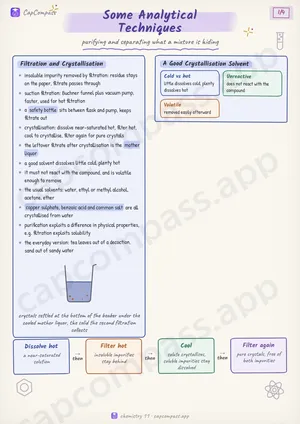
Filtration and Crystallisation
- insoluble impurity removed by filtration: residue stays on the paper, filtrate passes through
- suction filtration: Buchner funnel plus vacuum pump, faster, used for hot filtration
- a safety bottle sits between flask and pump, keeps filtrate out
- crystallisation: dissolve near-saturated hot, filter hot, cool to crystallise, filter again for pure crystals
- the leftover filtrate after crystallisation is the mother liquor
- a good solvent dissolves little cold, plenty hot
- it must not react with the compound, and is volatile enough to remove
- the usual solvents: water, ethyl or methyl alcohol, acetone, ether
- copper sulphate, benzoic acid and common salt are all crystallised from water
- purification exploits a difference in physical properties, e.g. filtration exploits solubility
- the everyday version: tea leaves out of a decoction, sand out of sandy water
A Good Crystallisation Solvent
- Cold vs hot: little dissolves cold, plenty dissolves hot
- Unreactive: does not react with the compound
- Volatile: removed easily afterward
- Dissolve hot: a near-saturated solution
- Filter hot: insoluble impurities stay behind
- Cool: solute crystallises, soluble impurities stay dissolved
- Filter again: pure crystals, free of both impurities
Page 1 of 4. The full sheet, all 4 pages, opens free in the app.
What this Some Analytical Techniques sheet covers
- Filtration and Crystallisation
- A Good Crystallisation Solvent
- Cold vs hot
- Unreactive
- Volatile
- Dissolve hot
- Filter hot
- Cool
- Filter again
- Fractional Crystallisation
- Distillation
- Fractional Distillation
- Distillation under Reduced Pressure
- How Close is Close, in Boiling Point
- Solvent Extraction
- Chromatography
- Building a Chromatography Column
- Adsorption vs Partition Chromatography
- Adsorption
- Partition
- Retention factor
- R_f, distance travelled by the solute over distance travelled by the solvent, same baseline
- Working Rf from a chromatogram
- Visualising a chromatogram
- Traps that cost marks
- Tricks that save time
How CapCompass uses this sheet
These notes are not a standalone PDF. CapCompass plans Chemistry chapter by chapter against your real exam dates and free hours, and when the plan reaches Some Analytical Techniques the sheet opens inside the study block itself — at the page covering the sub-topic that block is on, with the timer still running. Revision arrives at the moment the plan says revise, instead of having to be gone looking for.
More Chemistry Class 11 revision notes
- Adsorption and Colloids
- Basic Principles of Organic Chemistry
- Chemical Bonding
- Chemical Equilibrium
- Chemistry in Everyday Life
- Elements of Group 1 and 2
- Elements of Group 13, 14 and 15
- Hydrocarbons
- Introduction to Analytical Chemistry
- Modern Periodic Table
- Nuclear Chemistry and Radioactivity
- Redox Reactions
- Some Basic Concepts of Chemistry
- States of Matter
- Structure of Atom