Hydrocarbons — Class 11 Maharashtra HSC Chemistry revision notes
A 5-page visual revision sheet for Hydrocarbons, written for Class 11 Maharashtra HSC Chemistry. Formulas, diagrams and the traps that cost marks, laid out to be read the night before rather than the term before. Free, and it opens inside CapCompass.
 Page 1 as PDF
Hydrocarbons in one look
carbon and hydrogen only, and the bond type decides everything else
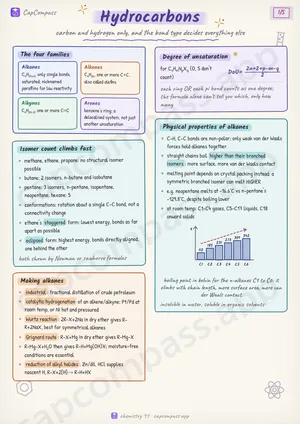
The four families
- Alkanes: C_nH_2n+2, only single bonds, saturated; nicknamed paraffins for low reactivity
- Alkenes: C_nH_2n, one or more C=C, also called olefins
- Alkynes: C_nH_2n-2, one or more C≡C
- Arenes: benzene's ring: a delocalised system, not just another unsaturation
Isomer count climbs fast
- methane, ethane, propane: no structural isomer possible
- butane: 2 isomers, n-butane and isobutane
- pentane: 3 isomers, n-pentane, isopentane, neopentane; hexane: 5
- conformations: rotation about a single C-C bond, not a connectivity change
- ethane's staggered form: lowest energy, bonds as far apart as possible
- eclipsed form: highest energy, bonds directly aligned, one behind the other
Making alkanes
- industrial: fractional distillation of crude petroleum
- catalytic hydrogenation of an alkene/alkyne: Pt/Pd at room temp, or Ni hot and pressured
- Wurtz reaction: 2R-X+2Na in dry ether gives R-R+2NaX, best for symmetrical alkanes
- Grignard route: R-X+Mg in dry ether gives R-Mg-X
- R-Mg-X+H_2O then gives R-H+Mg(OH)X; moisture-free conditions are essential
- reduction of alkyl halides: Zn/dil. HCl supplies nascent H, R-X+2[H]→ R-H+HX
Degree of unsaturation
- for C_nH_mN_pX_q (O, S don't count)
DoU=2n+2+p-m-q/2
Physical properties of alkanes
- C-H, C-C bonds are non-polar; only weak van der Waals forces hold alkanes together
- straight chains boil higher than their branched isomers: more surface, more van der Waals contact
- melting point depends on crystal packing instead: a symmetric branched isomer can melt HIGHER
- e.g. neopentane melts at -16.6°C vs n-pentane's -129.8°C, despite boiling lower
- at room temp: C1-C4 gases, C5-C17 liquids, C18 onward solids
Page 1 of 5. The full sheet, all 5 pages, opens free in the app.
What this Hydrocarbons sheet covers
- The four families
- Alkanes
- Alkenes
- Alkynes
- Arenes
- Isomer count climbs fast
- Making alkanes
- Degree of unsaturation
- for C_nH_mN_pX_q (O, S don't count)
- Physical properties of alkanes
- Alkanes: free-radical halogenation
- Other alkane reactions
- Free-radical chlorination of methane, one propagation cycle
- Making alkenes by elimination
- Making alkenes from alkynes
- Alkenes: electrophilic addition
- Markovnikov addition to propene
- More alkene reactions, matched to what they reveal
- Polymerization
- General formulae, at a glance
- Making and reacting alkynes
- Alkynes: addition, twice over
- Test for unsaturation
- Why benzene isn't cyclohexatriene
- Benzene versus an alkene, same tests
- Preparing benzene
- Benzene still adds, under forcing conditions
- Electrophilic substitution on benzene
- Directing effects, explained by resonance
- Traps that cost marks
- Tricks that save time
How CapCompass uses this sheet
These notes are not a standalone PDF. CapCompass plans Chemistry chapter by chapter against your real exam dates and free hours, and when the plan reaches Hydrocarbons the sheet opens inside the study block itself — at the page covering the sub-topic that block is on, with the timer still running. Revision arrives at the moment the plan says revise, instead of having to be gone looking for.
More Chemistry Class 11 revision notes
- Adsorption and Colloids
- Basic Principles of Organic Chemistry
- Chemical Bonding
- Chemical Equilibrium
- Chemistry in Everyday Life
- Elements of Group 1 and 2
- Elements of Group 13, 14 and 15
- Introduction to Analytical Chemistry
- Modern Periodic Table
- Nuclear Chemistry and Radioactivity
- Redox Reactions
- Some Analytical Techniques
- Some Basic Concepts of Chemistry
- States of Matter
- Structure of Atom