States of Matter — Class 11 Maharashtra HSC Chemistry revision notes
A 9-page visual revision sheet for States of Matter, written for Class 11 Maharashtra HSC Chemistry. Formulas, diagrams and the traps that cost marks, laid out to be read the night before rather than the term before. Free, and it opens inside CapCompass.
 Page 1 as PDF
States of Matter in one look
gases and liquids: what holds molecules together, and what a gas law says about how they move apart
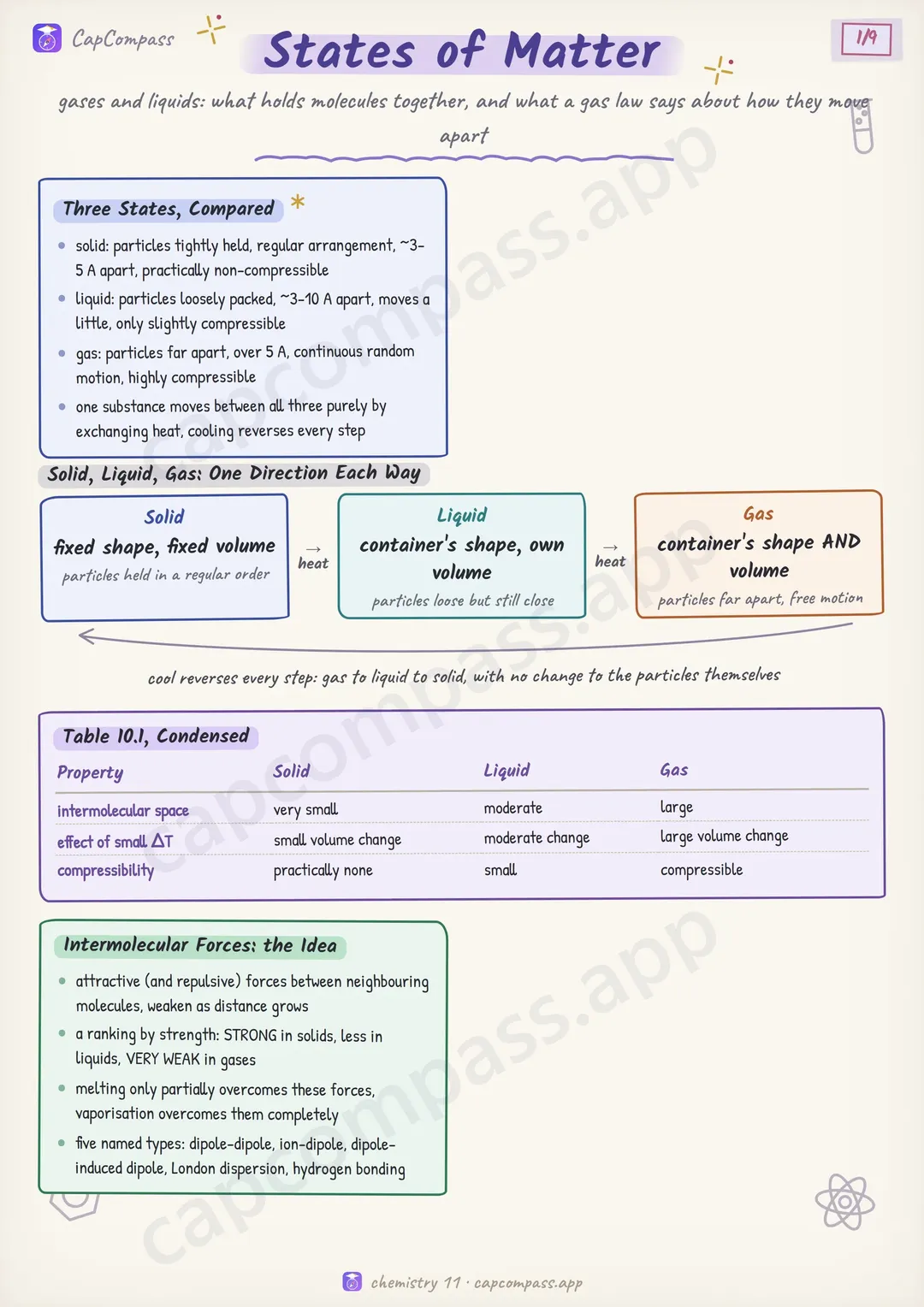
Three States, Compared
- solid: particles tightly held, regular arrangement, ~3-5 A apart, practically non-compressible
- liquid: particles loosely packed, ~3-10 A apart, moves a little, only slightly compressible
- gas: particles far apart, over 5 A, continuous random motion, highly compressible
- one substance moves between all three purely by exchanging heat, cooling reverses every step
Solid, Liquid, Gas: One Direction Each Way
- Solid: particles held in a regular order
- Liquid: particles loose but still close
- Gas: particles far apart, free motion
Table 10.1, Condensed
| Property | Solid | Liquid | Gas |
|---|---|---|---|
| intermolecular space | very small | moderate | large |
| effect of small Δ T | small volume change | moderate change | large volume change |
| compressibility | practically none | small | compressible |
Intermolecular Forces: the Idea
- attractive (and repulsive) forces between neighbouring molecules, weaken as distance grows
- a ranking by strength: STRONG in solids, less in liquids, VERY WEAK in gases
- melting only partially overcomes these forces, vaporisation overcomes them completely
- five named types: dipole-dipole, ion-dipole, dipole-induced dipole, London dispersion, hydrogen bonding
Page 1 of 9. The full sheet, all 9 pages, opens free in the app.
What this States of Matter sheet covers
- Three States, Compared
- Solid, Liquid, Gas: One Direction Each Way
- Solid
- Liquid
- Gas
- Table 10.1, Condensed
- Intermolecular Forces: the Idea
- Dipole-Dipole and Ion-Dipole
- Dipole-dipole
- Ion-dipole
- Dispersion Forces and Hydrogen Bonding
- Strength of Intermolecular Forces
- Characteristic Properties of Gases
- The Four Measurable Variables
- STP, Old and New
- Boyle's Law: Pressure and Volume
- Worked: Boyle's law
- Charles' Law: Temperature and Volume
- Gay-Lussac's Law: Pressure and Temperature
- Avogadro's Law and the Ideal Gas Equation
- The Ideal Gas Equation, and What It Yields
- the equation of state itself
- molar mass from measured P, V, T and mass m
- molar mass from a gas's density d
- combined gas law, one fixed mass across two states
- The Ideal Gas Equation, Held Fixed One Way
- Values of R
- Worked: new pressure from the combined gas law
- Dalton's Law of Partial Pressures
- Worked: partial pressures from mole fraction
- Kinetic Molecular Theory of Gases
- Real Gases and the Compressibility Factor
- Liquefaction and Critical Constants
- Critical Constants of Common Gases
- Ideal Gas vs Real Gas
- Ideal gas
- Real gas
- The Liquid State: Vapour Pressure
- Surface Tension and Viscosity
- Traps that cost marks
- Tricks that save time
How CapCompass uses this sheet
These notes are not a standalone PDF. CapCompass plans Chemistry chapter by chapter against your real exam dates and free hours, and when the plan reaches States of Matter the sheet opens inside the study block itself — at the page covering the sub-topic that block is on, with the timer still running. Revision arrives at the moment the plan says revise, instead of having to be gone looking for.
More Chemistry Class 11 revision notes
- Adsorption and Colloids
- Basic Principles of Organic Chemistry
- Chemical Bonding
- Chemical Equilibrium
- Chemistry in Everyday Life
- Elements of Group 1 and 2
- Elements of Group 13, 14 and 15
- Hydrocarbons
- Introduction to Analytical Chemistry
- Modern Periodic Table
- Nuclear Chemistry and Radioactivity
- Redox Reactions
- Some Analytical Techniques
- Some Basic Concepts of Chemistry
- Structure of Atom