Elements of Group 1 and 2 — Class 11 Maharashtra HSC Chemistry revision notes
A 8-page visual revision sheet for Elements of Group 1 and 2, written for Class 11 Maharashtra HSC Chemistry. Formulas, diagrams and the traps that cost marks, laid out to be read the night before rather than the term before. Free, and it opens inside CapCompass.
 Page 1 as PDF
Elements of Group 1 and 2 in one look
hydrogen alone at the top, then the alkali metals and the alkaline earths beneath
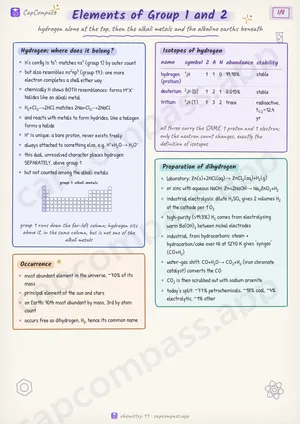
Hydrogen: where does it belong?
- H's config is 1s^1: matches ns^1 (group 1) by outer count
- but also resembles ns^2np^5 (group 17): one more electron completes a shell either way
- chemically H shows BOTH resemblances: forms M^+X^- halides like an alkali metal
- H_2+Cl_2→2HCl matches 2Na+Cl_2→2NaCl
- and reacts with metals to form hydrides, like a halogen forms a halide
- H^+ is unique: a bare proton, never exists freely
- always attached to something else, e.g. H^++H_2O→ H_3O^+
- this dual, unresolved character places hydrogen SEPARATELY, above group 1
- but not counted among the alkali metals
Occurrence
- most abundant element in the universe, ~70% of its mass
- principal element of the sun and stars
- on Earth: 10th most abundant by mass, 3rd by atom count
- occurs free as dihydrogen, H_2, hence its common name
Isotopes of hydrogen
| name | symbol | Z | A | N | abundance | stability |
|---|---|---|---|---|---|---|
| hydrogen (protium) | ^1_1H | 1 | 1 | 0 | 99.98% | stable |
| deuterium | ^2_1H (D) | 1 | 2 | 1 | 0.015% | stable |
| tritium | ^3_1H (T) | 1 | 3 | 2 | trace | radioactive, t_1/2=12.4 yr |
Preparation of dihydrogen
- laboratory: Zn(s)+2HCl(aq)→ ZnCl_2(aq)+H_2(g)
- or zinc with aqueous NaOH: Zn+2NaOH→ Na_2ZnO_2+H_2
- industrial electrolysis: dilute H_2SO_4 gives 2 volumes H_2 at the cathode per 1 O_2
- high-purity (>99.5%) H_2 comes from electrolysing warm Ba(OH)_2 between nickel electrodes
- industrial, from hydrocarbons: steam + hydrocarbon/coke over Ni at 1270 K gives 'syngas' (CO+H_2)
- water-gas shift: CO+H_2O→ CO_2+H_2 (iron chromate catalyst) converts the CO
- CO_2 is then scrubbed out with sodium arsenite
- today's split: ~77% petrochemicals, ~18% coal, ~4% electrolytic, ~1% other
Page 1 of 8. The full sheet, all 8 pages, opens free in the app.
What this Elements of Group 1 and 2 sheet covers
- Hydrogen: where does it belong?
- Occurrence
- Isotopes of hydrogen
- Preparation of dihydrogen
- Properties of dihydrogen
- Group 1 and group 2: introduction
- Condensed electronic configurations
- Trends in atomic and physical properties
- Worked: why is Mg's first I.E. higher than Na's?
- Reaction with oxygen/air
- Reaction with water, hydrogen and halogens
- Reducing nature and solution in liquid ammonia
- Worked: oxidation state of Na in Na2O2
- Diagonal relationship
- Li vs Mg
- Be vs Al
- Group 2, the same way down
- Uses, group 1
- Li
- Na
- K
- Cs
- Uses, group 2
- Be
- Mg-Al alloy
- Ca
- Ba
- Ra
- Biological roles
- Group 1 ions
- Group 2 ions
- Sodium carbonate, Na2CO3.10H2O (washing soda)
- Sodium hydroxide, NaOH (caustic soda)
- Calcium carbonate, CaCO3
- Hydrogen peroxide, H2O2
- Worked: percentage strength from volume strength
- Lithium aluminium hydride, LiAlH4
- Traps that cost marks
- Tricks that save time
How CapCompass uses this sheet
These notes are not a standalone PDF. CapCompass plans Chemistry chapter by chapter against your real exam dates and free hours, and when the plan reaches Elements of Group 1 and 2 the sheet opens inside the study block itself — at the page covering the sub-topic that block is on, with the timer still running. Revision arrives at the moment the plan says revise, instead of having to be gone looking for.
More Chemistry Class 11 revision notes
- Adsorption and Colloids
- Basic Principles of Organic Chemistry
- Chemical Bonding
- Chemical Equilibrium
- Chemistry in Everyday Life
- Elements of Group 13, 14 and 15
- Hydrocarbons
- Introduction to Analytical Chemistry
- Modern Periodic Table
- Nuclear Chemistry and Radioactivity
- Redox Reactions
- Some Analytical Techniques
- Some Basic Concepts of Chemistry
- States of Matter
- Structure of Atom