Modern Periodic Table — Class 11 Maharashtra HSC Chemistry revision notes
A 6-page visual revision sheet for Modern Periodic Table, written for Class 11 Maharashtra HSC Chemistry. Formulas, diagrams and the traps that cost marks, laid out to be read the night before rather than the term before. Free, and it opens inside CapCompass.
 Page 1 as PDF
Modern Periodic Table in one look
118 boxes, four blocks, and one number, Z, that predicts almost all of it
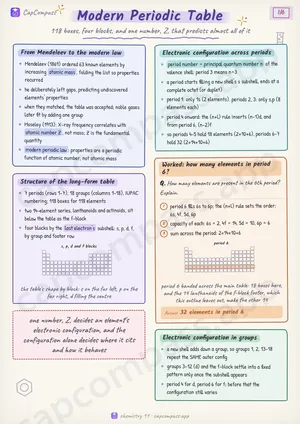
From Mendeleev to the modern law
- Mendeleev (1869) ordered 63 known elements by increasing atomic mass, folding the list so properties recurred
- he deliberately left gaps, predicting undiscovered elements' properties
- when they matched, the table was accepted; noble gases later fit by adding one group
- Moseley (1913): X-ray frequency correlates with atomic number Z, not mass; Z is the fundamental quantity
- modern periodic law: properties are a periodic function of atomic number, not atomic mass
Structure of the long-form table
- 7 periods (rows 1-7), 18 groups (columns 1-18), IUPAC numbering; 118 boxes for 118 elements
- two 14-element series, lanthanoids and actinoids, sit below the table as the f-block
- four blocks by the last electron's subshell: s, p, d, f, by group and footer row
Electronic configuration across periods
- period number = principal quantum number n of the valence shell: period 3 means n=3
- a period starts filling a new shell's s subshell, ends at a complete octet (or duplet)
- period 1: only 1s (2 elements). periods 2, 3: only s,p (8 elements each)
- period 4 onward: the (n+l) rule inserts (n-1)d, and from period 6, (n-2)f
- so periods 4-5 hold 18 elements (2+10+6), periods 6-7 hold 32 (2+14+10+6)
Worked: how many elements in period 6?
Q. How many elements are present in the 6th period? Explain.
- period 6 fills 6s to 6p; the (n+l) rule sets the order: 6s, 4f, 5d, 6p
- capacity of each: 6s = 2, 4f = 14, 5d = 10, 6p = 6
- sum across the period: 2+14+10+6
Answer: 32 elements in period 6
Electronic configuration in groups
- a new shell adds down a group, so groups 1, 2, 13-18 repeat the SAME outer config
- groups 3-12 (d) and the f-block settle into a fixed pattern only once the subshell appears
- period 4 for d, period 6 for f; before that the configuration still varies
Page 1 of 6. The full sheet, all 6 pages, opens free in the app.
What this Modern Periodic Table sheet covers
- From Mendeleev to the modern law
- Structure of the long-form table
- Electronic configuration across periods
- Worked: how many elements in period 6?
- Electronic configuration in groups
- General outer configuration by group
- The four blocks: outer configuration
- s-block
- p-block
- d-block
- f-block
- Worked: locating Au from its configuration
- Blockwise character
- Effective nuclear charge and screening
- Effective nuclear charge
- effective nuclear charge, Z minus the shielding constant
- Atomic radius
- Ionic radius
- Worked: ranking Na, Na+, Mg2+ by size
- Ionisation enthalpy
- Electron gain enthalpy
- Electronegativity
- Every trend, at a glance
- Valency and its periodic trend
- Metallic-nonmetallic character and reactivity
- Traps that cost marks
- Tricks that save time
How CapCompass uses this sheet
These notes are not a standalone PDF. CapCompass plans Chemistry chapter by chapter against your real exam dates and free hours, and when the plan reaches Modern Periodic Table the sheet opens inside the study block itself — at the page covering the sub-topic that block is on, with the timer still running. Revision arrives at the moment the plan says revise, instead of having to be gone looking for.
More Chemistry Class 11 revision notes
- Adsorption and Colloids
- Basic Principles of Organic Chemistry
- Chemical Bonding
- Chemical Equilibrium
- Chemistry in Everyday Life
- Elements of Group 1 and 2
- Elements of Group 13, 14 and 15
- Hydrocarbons
- Introduction to Analytical Chemistry
- Nuclear Chemistry and Radioactivity
- Redox Reactions
- Some Analytical Techniques
- Some Basic Concepts of Chemistry
- States of Matter
- Structure of Atom