Introduction to Analytical Chemistry — Class 11 Maharashtra HSC Chemistry revision notes
A 5-page visual revision sheet for Introduction to Analytical Chemistry, written for Class 11 Maharashtra HSC Chemistry. Formulas, diagrams and the traps that cost marks, laid out to be read the night before rather than the term before. Free, and it opens inside CapCompass.
 Page 1 as PDF
Introduction to Analytical Chemistry in one look
how much is uncertain, how many figures say so, and what a reaction actually yields
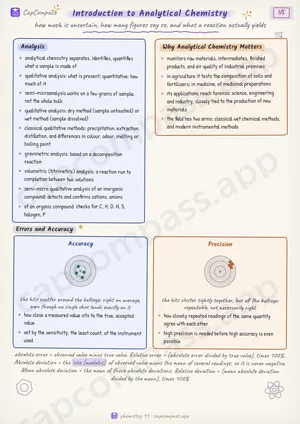
Analysis
- analytical chemistry separates, identifies, quantifies what a sample is made of
- qualitative analysis: what is present; quantitative: how much of it
- semi-microanalysis works on a few grams of sample, not the whole bulk
- qualitative analysis: dry method (sample untouched) or wet method (sample dissolved)
- classical qualitative methods: precipitation, extraction, distillation, and differences in colour, odour, melting or boiling point
- gravimetric analysis: based on a decomposition reaction
- volumetric (titrimetric) analysis: a reaction run to completion between two solutions
- semi-micro qualitative analysis of an inorganic compound: detects and confirms cations, anions
- of an organic compound: checks for C, H, O, N, S, halogen, P
Why Analytical Chemistry Matters
- monitors raw materials, intermediates, finished products, and air quality of industrial premises
- in agriculture it tests the composition of soils and fertilizers; in medicine, of medicinal preparations
- its applications reach forensic science, engineering and industry, closely tied to the production of new materials
- the field has two arms: classical wet chemical methods, and modern instrumental methods
Errors and Accuracy
- how close a measured value sits to the true, accepted value
- set by the sensitivity, the least count, of the instrument used
- how closely repeated readings of the same quantity agree with each other
- high precision is needed before high accuracy is even possible
Page 1 of 5. The full sheet, all 5 pages, opens free in the app.
What this Introduction to Analytical Chemistry sheet covers
- Analysis
- Why Analytical Chemistry Matters
- Errors and Accuracy
- Accuracy
- Precision
- Reading a burette
- Significant Figures
- Rounding off
- digit below 5
- digit 5 or above
- a calculated result
- adding or subtracting
- multiplying or dividing
- scientific notation
- Arithmetic in scientific notation
- adding or subtracting: make the exponents equal FIRST, then add the coefficients
- multiplying: multiply the coefficients, ADD the exponents
- dividing: divide the coefficients, SUBTRACT the exponents
- Empirical and Molecular Formula
- Empirical formula, worked
- Empirical formula, worked with oxygen by difference
- Stoichiometry
- Limiting Reagent
- Concentration Terms
- mass percent, w/w: solute over solution
- mole fraction of a component
- molarity: moles of solute per litre of solution
- molality: moles of solute per kg of solvent
- Concentration: special cases
- Reading a graph
- Symbols
- Traps that cost marks
- Tricks that save time
How CapCompass uses this sheet
These notes are not a standalone PDF. CapCompass plans Chemistry chapter by chapter against your real exam dates and free hours, and when the plan reaches Introduction to Analytical Chemistry the sheet opens inside the study block itself — at the page covering the sub-topic that block is on, with the timer still running. Revision arrives at the moment the plan says revise, instead of having to be gone looking for.
More Chemistry Class 11 revision notes
- Adsorption and Colloids
- Basic Principles of Organic Chemistry
- Chemical Bonding
- Chemical Equilibrium
- Chemistry in Everyday Life
- Elements of Group 1 and 2
- Elements of Group 13, 14 and 15
- Hydrocarbons
- Modern Periodic Table
- Nuclear Chemistry and Radioactivity
- Redox Reactions
- Some Analytical Techniques
- Some Basic Concepts of Chemistry
- States of Matter
- Structure of Atom