Basic Principles of Organic Chemistry — Class 11 Maharashtra HSC Chemistry revision notes
A 6-page visual revision sheet for Basic Principles of Organic Chemistry, written for Class 11 Maharashtra HSC Chemistry. Formulas, diagrams and the traps that cost marks, laid out to be read the night before rather than the term before. Free, and it opens inside CapCompass.
 Page 1 as PDF
Basic Principles of Organic Chemistry in one look
how a molecule is drawn, named, classified, and how its bonds break
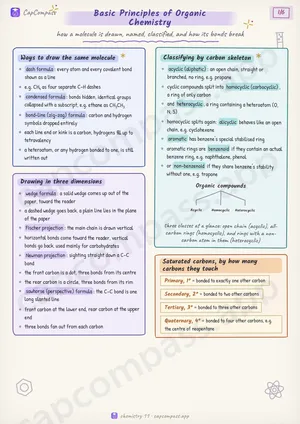
Ways to draw the same molecule
- dash formula: every atom and every covalent bond shown as a line
- e.g. CH_4 as four separate C-H dashes
- condensed formula: bonds hidden, identical groups collapsed with a subscript, e.g. ethane as CH_3CH_3
- bond-line (zig-zag) formula: carbon and hydrogen symbols dropped entirely
- each line end or kink is a carbon, hydrogens fill up to tetravalency
- a heteroatom, or any hydrogen bonded to one, is still written out
Drawing in three dimensions
- wedge formula: a solid wedge comes up out of the paper, toward the reader
- a dashed wedge goes back, a plain line lies in the plane of the paper
- Fischer projection: the main chain is drawn vertical
- horizontal bonds come toward the reader, vertical bonds go back, used mainly for carbohydrates
- Newman projection: sighting straight down a C-C bond
- the front carbon is a dot, three bonds from its centre
- the rear carbon is a circle, three bonds from its rim
- sawhorse (perspective) formula: the C-C bond is one long slanted line
- front carbon at the lower end, rear carbon at the upper end
- three bonds fan out from each carbon
Classifying by carbon skeleton
- acyclic (aliphatic): an open chain, straight or branched, no ring, e.g. propane
- cyclic compounds split into homocyclic (carbocyclic), a ring of only carbon
- and heterocyclic, a ring containing a heteroatom (O, N, S)
- homocyclic splits again: alicyclic behaves like an open chain, e.g. cyclohexene
- aromatic has benzene's special stabilised ring
- aromatic rings are benzenoid if they contain an actual benzene ring, e.g. naphthalene, phenol
- or non-benzenoid if they share benzene's stability without one, e.g. tropone
Saturated carbons, by how many carbons they touch
- Primary, 1°
- bonded to exactly one other carbon
- Secondary, 2°
- bonded to two other carbons
- Tertiary, 3°
- bonded to three other carbons
- Quaternary, 4°
- bonded to four other carbons, e.g. the centre of neopentane
Page 1 of 6. The full sheet, all 6 pages, opens free in the app.
What this Basic Principles of Organic Chemistry sheet covers
- Ways to draw the same molecule
- Drawing in three dimensions
- Classifying by carbon skeleton
- Saturated carbons, by how many carbons they touch
- Naming an alkyl branch
- Small branched alkyl groups, trivial names
- Numbering a branched chain
- Naming alkenes, alkynes and rings
- Naming a substituted benzene
- Suffix seniority for the principal group
- Structural isomerism, five flavours
- Stereoisomerism: same bonds, different arrangement in space
- Comparing carbocation stability
- Inductive effect: a bond, not a jump
- Resonance: which structure matters most
- Electromeric effect and hyperconjugation
- Reaction intermediates
- Carbocation
- Carbanion
- Free radical
- Carbene
- Bond fission and reagent type
- Three basic reaction shapes, by what happens to the bonds
- Traps that cost marks
- Tricks that save time
How CapCompass uses this sheet
These notes are not a standalone PDF. CapCompass plans Chemistry chapter by chapter against your real exam dates and free hours, and when the plan reaches Basic Principles of Organic Chemistry the sheet opens inside the study block itself — at the page covering the sub-topic that block is on, with the timer still running. Revision arrives at the moment the plan says revise, instead of having to be gone looking for.
More Chemistry Class 11 revision notes
- Adsorption and Colloids
- Chemical Bonding
- Chemical Equilibrium
- Chemistry in Everyday Life
- Elements of Group 1 and 2
- Elements of Group 13, 14 and 15
- Hydrocarbons
- Introduction to Analytical Chemistry
- Modern Periodic Table
- Nuclear Chemistry and Radioactivity
- Redox Reactions
- Some Analytical Techniques
- Some Basic Concepts of Chemistry
- States of Matter
- Structure of Atom